Lithologic Reservoirs ›› 2026, Vol. 38 ›› Issue (1): 78-88.doi: 10.12108/yxyqc.20260107

• PETROLEUM EXPLORATION • Previous Articles     Next Articles

Seismic prediction method for thin sandstone reservoirs in shallow water delta front: A case study of the second member of Jurassic Penglaizhen Formation in Western Sichuan Depression

TIAN Wenzhong1(), QIAO Lin1, YUAN Jian1, LI Xingwen1, XIANG Lei1, WANG Changcheng2(), LU Gang2, LU Xihe2   

  1. 1 No. 1 Gas Production PlantSouthwest Oil & Gas Company, SinopecDeyang 618000, Sichuan, China
    2 College of EnergyChengdu University of TechnologyChengdu 610059, China
  • Received:2025-07-10 Revised:2025-08-29 Online:2026-01-01 Published:2026-01-23
  • Contact: WANG Changcheng E-mail:tianwenzhong1979@163.com;wcc-126@163.com

Abstract:

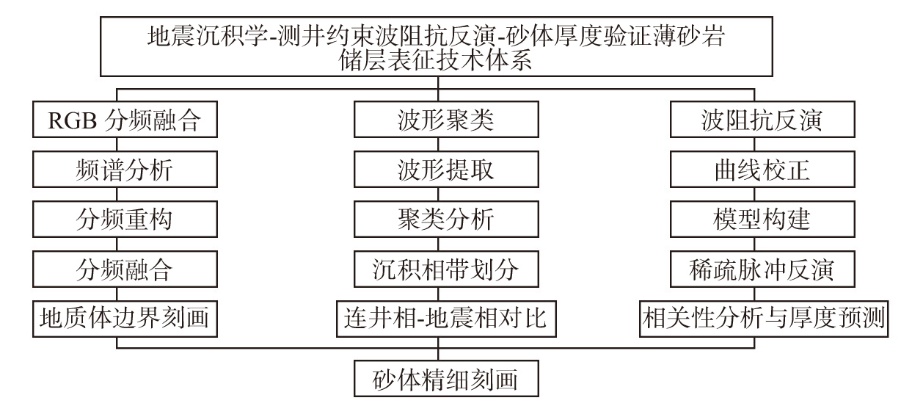
By integrating seismic and logging interpretation data, a three-in-one characterization technology system for thin sandstone reservoir of “multi-scale seismic sedimentology analysis-logging constrained wave impe-dance inversion-sand body thickness verification” was established. And through seismic attribute analysis, frequency division RGB fusion, and waveform clustering analysis, the sedimentary microfacies and distribution of channel sand bodies of the second member of Jurassic Penglaizhen Formation in Western Sichuan Depression were cha-racterized. The results show that:(1) The reservoir of the second member of Jurassic Penglaizhen Formation in Western Sichuan Depression is mainly composed of underwater distributary channel sand bodies, with logging response feature of “low gamma box curve”, and seismic response feature of “a strong peak and corresponding strong valley reflection”. The establishment of an isochronous stratigraphic framework and isochronous comparisons of well-seismic consistency can improve the accuracy of stratigraphic interpretation. (2) The sedimentary microfacies of the second member of Penglaizhen Formation in the study area are mainly underwater distributary channels and distributary channel bays. JP33-1 sublayer is compopsed of underwater distributary channel deposits, with two channels developed: a northeast-southwest trending one and an east-west trending one. And the northeast-southwest trending channel is wider in development and greater in thickness, making it a key area for further exploration and development. (3) The underwater distributary channel sand bodies of the second member of Penglaizhen Formation in the study area exhibit the geophysical response characteristic of “medium-low impe-dance”.The integrated characterization technology system for thin sandstone reservoir of “multi-scale seismic sedimentology analysis-logging constrained wave impedance inversion-sand body thickness verification”can improve the accuracy of predicting sand body thickness, with correlation coefficient of 0.886 5 between inversion prediction thickness and logging interpretation thickness. The main channel sand body thickness is large, ranging from 10 to 20 m, and the distributary channel sand body thickness is small, ranging from 5 to 10 m.

Key words: seismic sedimentology, shallow water delta, thin sandstone reservoir, isochronous stratigraphic frame-work, RGB fusion, wave impedance inversion, seismic prediction, Penglaizhen Formation, Jurassic, Western Sichuan Depression

CLC Number: 

  • TE121.3

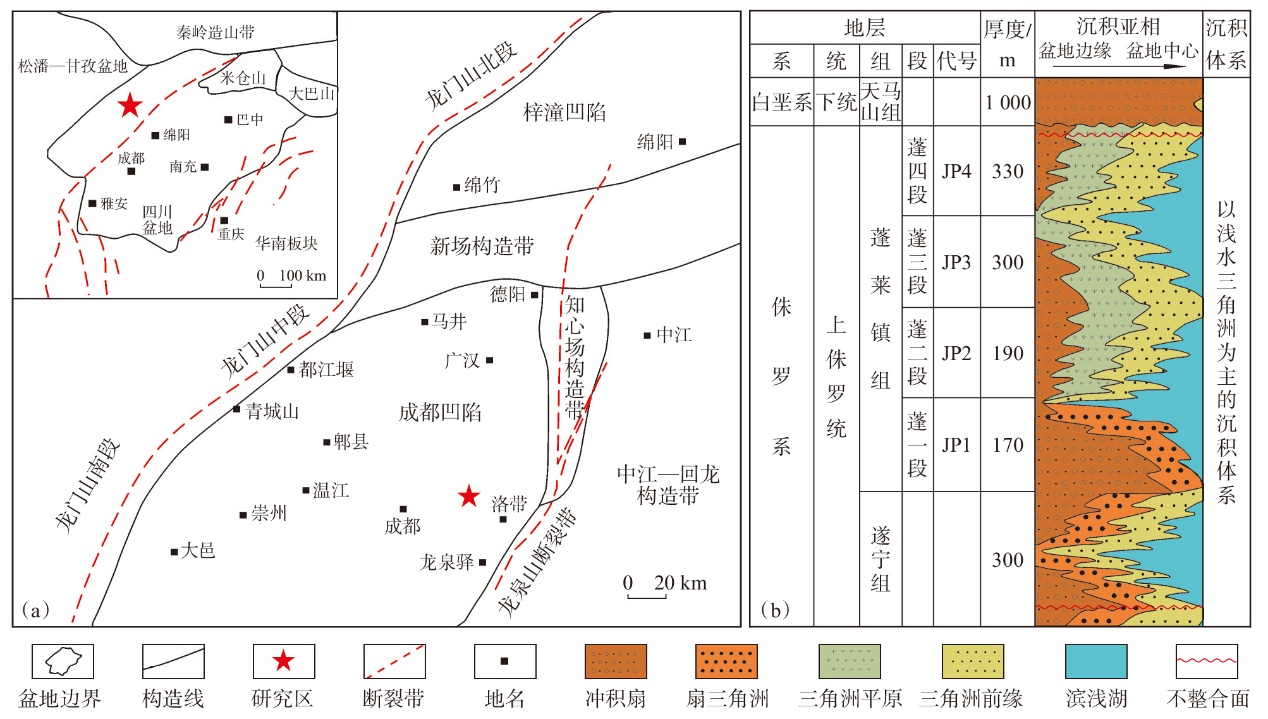
Fig. 1

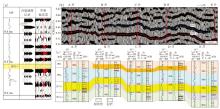
Structural location of Western Sichuan Depression (a) and comprehensive stratigraphic column of Jurassic Penglaizhen Formation (b)"

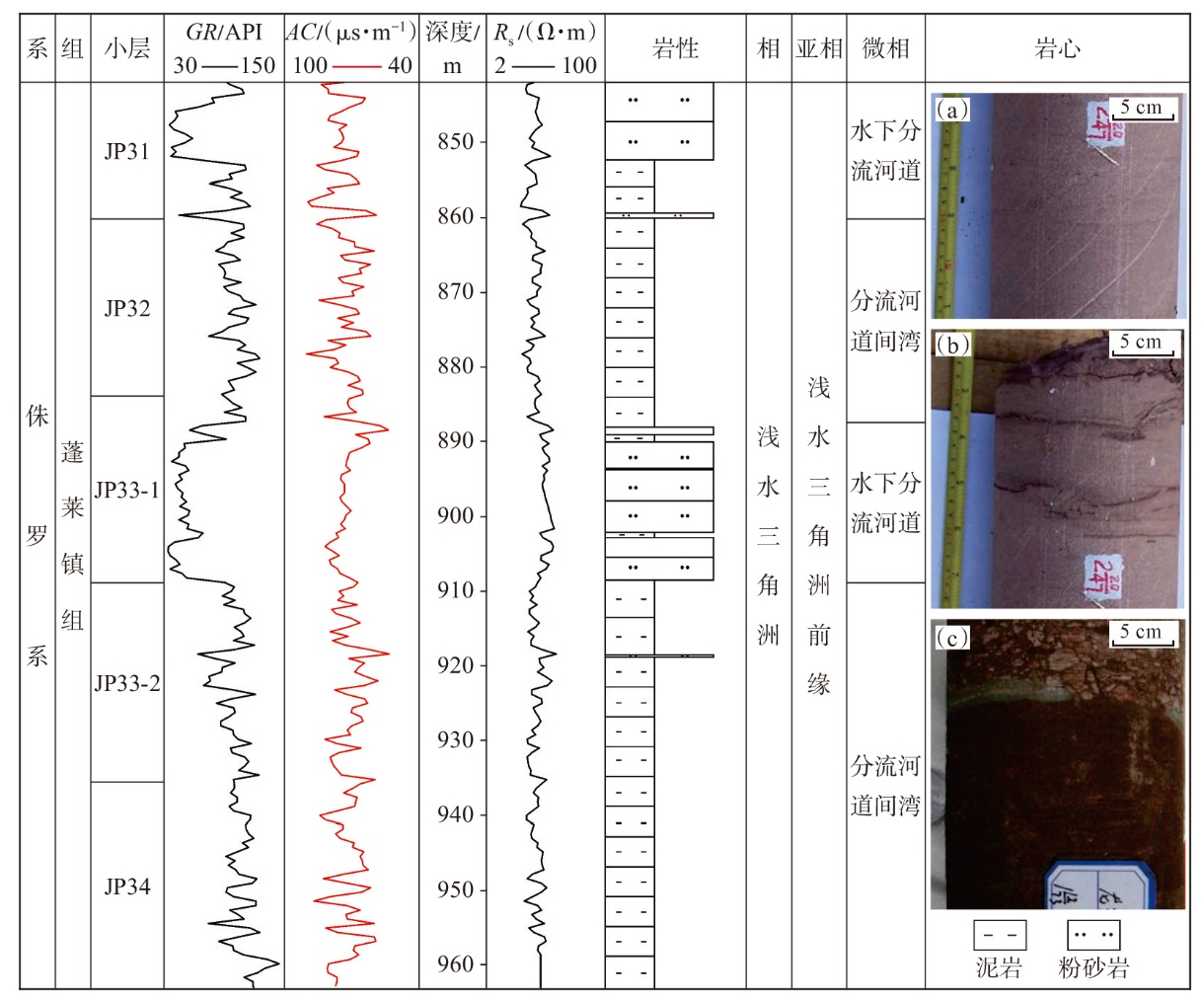
Fig. 2

Comprehensive stratigraphic column of well S in Jurassic Penglaizhen Formation of Western Sichuan Depression"

Fig. 3

Well-seismic calibration (a) , seismic profile (b) and comparison of well-tie sections (c) of the second member of Jurassic Penglaizhen Formation in Western Sichuan Depression"

Fig. 4

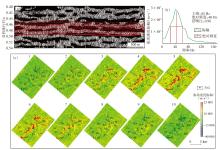
Stratigraphic section (a) , spectrum analysis (b) and seismic attribute plan (c) of the second member of Jurassic Penglaizhen Formation in Western Sichuan Depression"

Fig. 5

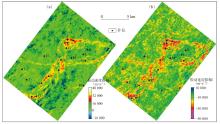
Peak attributes (a) and valley attributes (b) of JP33-1 sublayer in the second member of Jurassic Penglaizhen Formation of Western Sichuan Depression"

Fig. 6

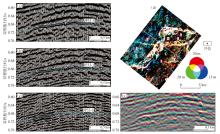
Frequency division profiles of 30 Hz (a), 45 Hz (b), 60 Hz (c) and RGB fusion maps (d—e) of JP33-1 sublayer in the second member of Jurassic Penglaizhen Formation in Western Sichuan Depression"

Fig. 7

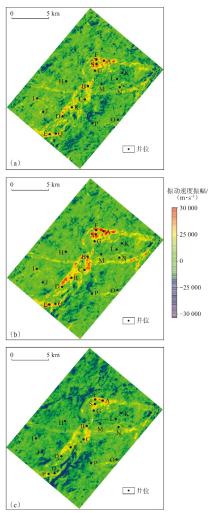
Frequency division peak amplitude attribute of 30 Hz (a), 45 Hz (b), 60 Hz (c) of JP33-1 sublayer in the second member of Jurassic Penglaizhen Formation in Western Sichuan Depression"

Fig. 8

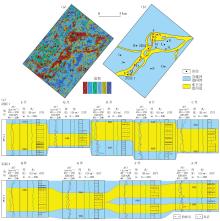
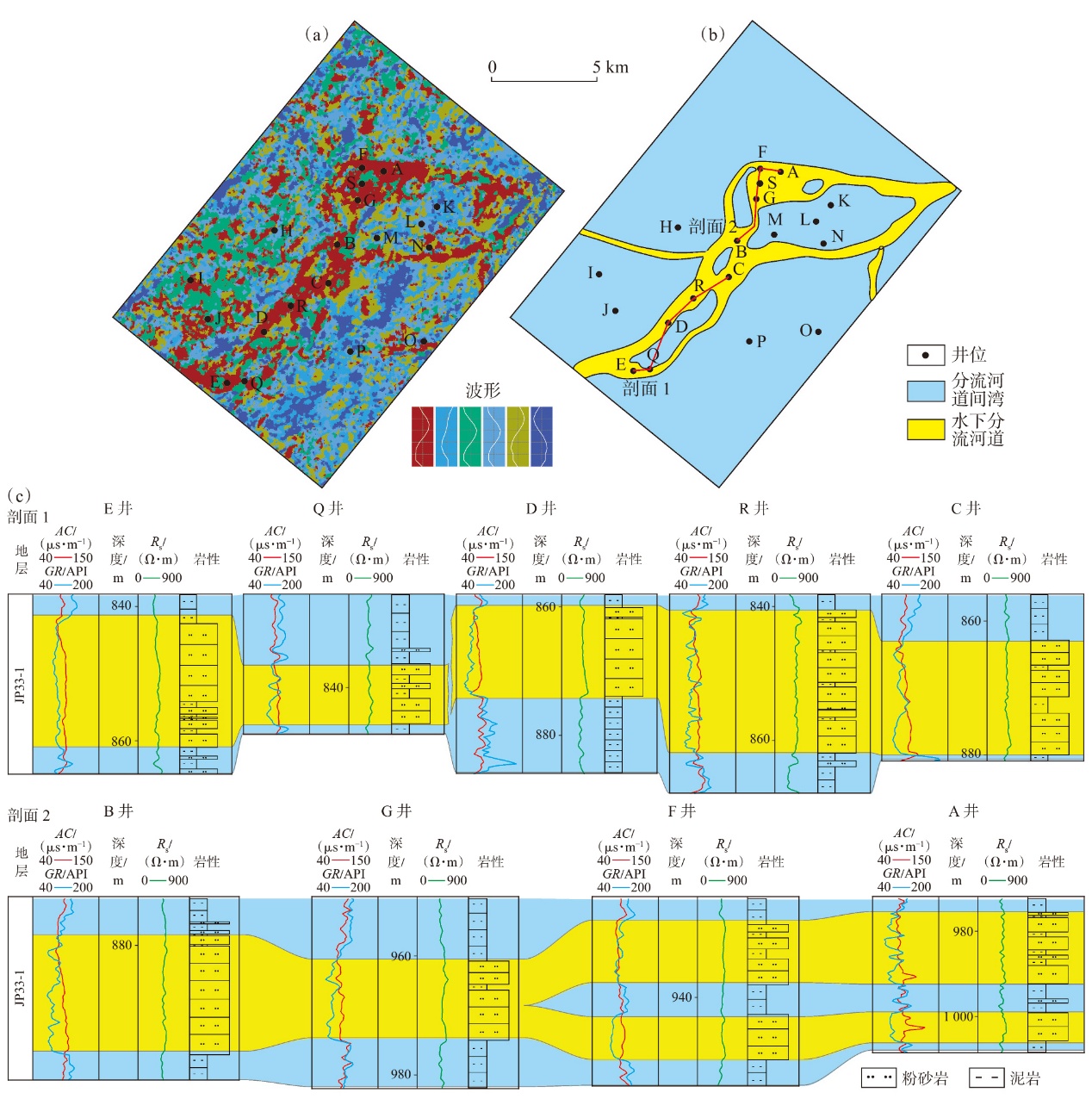
Waveform clustering (a), distribution of sedimentary microfacies (b), and comparison of well-tie facies (c) of JP33-1 sublayer in the second member of Jurassic Penglaizhen Formation in Western Sichuan Depression"

Fig. 9

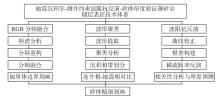
Characterization technology system for thin sandstone reservoir based on seismic sedimentology- logging constrained wave impedance inversion-sand body thickness verification"

Fig. 10

Wave impedance inversion (a), sand body thickness prediction (b), and correlation between wave impedance inversion and sand body thickness (c) of JP33-1 sublayer in Jurassic Penglaizhen Formation, Western Sichuan Depression"

[1] 李宏涛, 马立元, 史云清, 等. 基于井-震结合的水下分流河道砂岩储层展布分析与评价:以什邡气藏JP35砂组为例[J]. 岩性油气藏, 2020, 32(2):78-89.
doi: 10.12108/yxyqc.20200208
LI Hongtao, MA Liyuan, SHI Yunqing, et al. Distribution and evaluation of underwater distributary channel sandstone reservoir based on well-seismic combination:A case study of JP35sand group in Shifang gas reservoir[J]. Lithologic Reservoirs, 2020, 32(2):78-89.
doi: 10.12108/yxyqc.20200208
[2] 邓浩阳, 司马立强, 吴玟, 等. 致密砂岩储层孔隙结构分形研究与渗透率计算:以川西坳陷蓬莱镇组、沙溪庙组储层为例[J]. 岩性油气藏, 2018, 30(6):76-82.
doi: 10.12108/yxyqc.20180609
DENG Haoyang, SIMA Liqiang, WU Wen, et al. Fractal cha-racteristics of pore structure and permeability calculation for tight sandstone reservoirs:A case of Penglaizhen Formation and Shaximiao Formation in Western Sichuan Depression[J]. Lithologic Reservoirs, 2018, 30(6):76-82.
doi: 10.12108/yxyqc.20180609
[3] 胡向阳, 李宏涛, 史云清, 等. 川西坳陷斜坡带蓬莱镇组三段沉积特征与储层分布:以什邡地区JP23砂组为例[J]. 天然气地球科学, 2018, 29(4):468-480.
doi: 10.11764/j.issn.1672-1926.2018.03.010
HU Xiangyang, LI Hongtao, SHI Yunqing, et al. Sedimentary characteristics and reservoirs distribution from Penglaizhen Formation 3rd member in slope belt of Western Sichuan Depression:A case study of JP23sandstone group from Shifang area[J]. Natural Gas Geoscience, 2018, 29(4):468-480.
doi: 10.11764/j.issn.1672-1926.2018.03.010
[4] 袁玥. 新都气田蓬莱镇组气藏挖潜评价[D]. 成都: 成都理工大学, 2020.
YUAN Yue. Potential tapping evaluation of Penglaizhen Formation gas reservoir Xindu Gasfield[D]. Chengdu: Chengdu Uni-versity of Technology, 2020.
[5] 王铮. 基于井震一体化的洛带蓬莱镇组一段沉积相综合研究[D]. 成都: 成都理工大学, 2022.
WANG Zheng. Comprehensive study on sedimentary facies of the first member of Penglaizhen Formation in Luodai based on well-seismic integration[D]. Chengdu: Chengdu University of Technology, 2022.
[6] 胡兴杰. 川西洛带气田蓬莱镇组地震储层预测[D]. 成都: 成都理工大学, 2021.
HU Xingjie. Seismic reservoir prediction of Penglaizhen Forma-tion in Luodai gas field,Western Sichuan[D]. Chengdu: Cheng-du University of Technology, 2021.
[7] 庄彬. 川西洛带气田蓬莱镇组二段JP3砂组沉积微相及优质储层预测[D]. 成都: 成都理工大学, 2023.
ZHUANG Bin. Sedimentary microfacies and high-quality reservoirs prediction of JP3 sand group in the second section of Peng-laizhen Formation, Luodai gas field,Western Sichuan[D]. Cheng-du: Chengdu University of Technology, 2023.
[8] 刘兴艳, 李墨寒, 叶泰然. 川西侏罗系复杂河道精细刻画及沉积相带识别[J]. 石油物探, 2019, 58(5):750-757.
doi: 10.3969/j.issn.1000-1441.2019.05.014
LIU Xingyan, LI Mohan, YE Tairan. Fine characterization of complicated channels in western Sichuan and identification of sedimentary facies[J]. Geophysical Prospecting for Petroleum, 2019, 58(5):750-757.
doi: 10.3969/j.issn.1000-1441.2019.05.014
[9] 邓莉, 刘君龙, 钱玉贵, 等. 川西地区龙门山前带侏罗系物源与沉积体系演化[J]. 石油与天然气地质, 2019, 40(2):380-391.
DENG Li, LIU Junlong, QIAN Yugui, et al. Provenance and sedimentary system of the Jurassic successions in the front of Longmen Mountain in western Sichuan Basin[J]. Oil & Gas Geology, 2019, 40(2):380-391.
[10] 熊坤, 王洪辉, 何丹, 等. 洛带气田蓬莱镇组沉积相研究[J]. 四川文理学院学报, 2013, 23(2):44-48.
XIONG Kun, WANG Honghui, HE Dan, et al. Research on the sedimentary facies of Penglai layer in Luodai gas field[J]. Sichuan University of Arts and Science Journal, 2013, 23(2):44-48.
[11] 尹朝云, 刘伟, 罗长川. 洛带气田蓬莱镇组气藏储层及储量评价研究[J]. 断块油气田, 2007, 44(3):44-46.
YIN Chaoyun, LIU Wei, LUO Changchuan. Research on Peng-laizhen Formation gas reservoir in Luodai gas field and its reserve evaluation[J]. Fault-Block Oil & Gas Field, 2007, 44(3):44-46.
[12] 张坤, 刘宏, 谭磊, 等. 川中北部蓬莱地区震旦系灯影组二段地震沉积学特征[J]. 岩性油气藏, 2025, 37(2):189-200.
doi: 10.12108/yxyqc.20250217
ZHANG Kun, LIU Hong, TAN Lei, et al. Seismic sedimentology characteristics of the second member of Sinian Dengying Forma-tion in Penglai area,north-central Sichuan Basin[J]. Lithologic Reservoirs, 2025, 37(2):189-200.
doi: 10.12108/yxyqc.20250217
[13] 徐世东, 陈书平, 薛佳雯, 等. 井震数据联合驱动下砂体叠置模式构建技术及应用:以WX油田东北部姚家组葡萄花油层为例[J]. 石油地球物理勘探, 2023, 58(1):178-189.
XU Shidong, CHEN Shuping, XUE Jiawen, et al. Construction technology of superimposition patterns of sandbodies driven by well-seismic data and its application:Taking the Putaohua reservoir of Yaojia Formation in the northeastern WX Oilfield as an example[J]. Oil Geophysical Prospecting, 2023, 58(1):178-189.
[14] 李宏涛. 基于井-震联合的辫状河沉积微相分析:以鄂尔多斯盆地东胜气田锦77井区为例[J]. 石油与天然气地质, 2025, 46(1):91-107.
LI Hongtao. Microfacies analysis of braided river deposits based on seismic-to-well ties:A case study of the Jin-77 well block in the Dongsheng gas field,Ordos Basin[J]. Oil & Gas Geology, 2025, 46(1):91-107.
[15] 杨春生, 焦艳丽, 蔡东梅, 等. 井-震结合曲流型储层构型研究及应用:以大庆长垣西部斜坡区为例[J]. 石油地球物理勘探, 2024, 59(6):1330-1339.
YANG Chunsheng, JIAO Yanli, CAI Dongmei, et al. Meandering reservoir architecture based on well-seismic analysis and its deve-lopment and application:Taking the western slope area of Daqing Oilfield as an example[J]. Oil Geophysical Prospecting, 2024, 59(6):1330-1339.
[16] 娄敏, 蔡华, 何贤科, 等. 地震沉积学在东海陆架盆地西湖凹陷河流-三角洲相储集层刻画中的应用[J]. 石油勘探与开发, 2023, 50(1):125-138.
doi: 10.11698/PED.20220204
LOU Min, CAI Hua, HE Xianke, et al. Application of seismic sedimentology in characterization of fluvial-deltaic reservoirs in Xihu sag,East China Sea shelf basin[J]. Petroleum Exploration and Development, 2023, 50(1):125-138.
doi: 10.1016/S1876-3804(22)60374-4
[17] 朱筱敏, 刘长利, 张义娜, 等. 地震沉积学在陆相湖盆三角洲砂体预测中的应用[J]. 沉积学报, 2009, 27(5):915-921.
ZHU Xiaomin, LIU Changli, ZHANG Yina, et al. On seismic sedimentology of lacustrine deltaic depositional systems[J]. Acta Sedimentologica Sinica, 2009, 27(5):915-921.
[18] 王剑, 吴亚宁, 王涛, 等. 地震分频多级稀疏正则化反演方法:以渤中凹陷石臼坨凸起古近系东营组二段为例[J]. 岩性油气藏, 2025, 37(4):38-49.
doi: 10.12108/yxyqc.20250404
WANG Jian, WU Yaning, WANG Tao, et al. Multi-level sparse regularization inversion method for seismic frequency division:A case study from the second member of Paleogene Dongying Formation in Shijiutuo Uplift,Bozhong Sag[J]. Lithologic Reser-voirs, 2025, 37(4):38-49.
[19] 刘迎宝, 李元昊, 翟文彬, 等. 极缓坡湖盆浅水三角洲前缘砂体类型及成因模式:以鄂尔多斯盆地郝滩地区三叠系长81亚段为例[J]. 岩性油气藏, 2025, 37(3):140-152.
doi: 10.12108/yxyqc.20250313
LIU Yingbao, LI Yuanhao, ZHAI Wenbin, et al. Types and genetic models of sand bodies in shallow water delta front of extremely gentle slope lake basin:A case study of Chang 81submember of Triassic in Haotan area,Ordos Basin[J]. Lithologic Reservoirs, 2025, 37(3):140-152.
doi: 10.12108/yxyqc.20250313
[20] 张阳, 邱隆伟, 李际, 等. 基于模糊C均值地震属性聚类的沉积相分析[J]. 中国石油大学学报(自然科学版), 2015, 39(4):53-61.
ZHANG Yang, QIU Longwei, LI Ji, et al. Sedimentary facies analysis based on cluster of seismic attributes by fuzzy C-means algorithm[J]. Journal of China University of Petroleum(Edition of Natural Science), 2015, 39(4):53-61.
[1] MENG Yang, CAO Xiaopeng, ZHAO Hao, YANG Minglin, LI Zhipeng, TIAN Zhenlei, WU Hongcui, JIANG Yue. Development characteristics and main controlling factors of natural fractures of Jurassic Qigu Formation in Yongjin area, Junggar Basin [J]. Lithologic Reservoirs, 2026, 38(1): 13-25.
[2] ZHANG Mengbo, PENG Jiankang, CUI Xiaojie, ZHANG Dong, NI Na, LONG Shengfang, WEI Penghui. Seismic prediction technology for coal rock gas reservoir of Carboniferous Benxi Formation in northern Mizhi area, Ordos Basin [J]. Lithologic Reservoirs, 2026, 38(1): 162-171.
[3] MA Daibing, MA Wentao, HAN Wenyuan, CHEN Shangbin, GUO Xingxing. Reservoir formation condition and favorable areas optimization of coalbed methane of Jurassic Yaojie Formation in Yaojie mining area, Minhe Basin [J]. Lithologic Reservoirs, 2026, 38(1): 26-37.
[4] YIN Jiang, JIAO Xuejun, LI Xiaolong, LI Taifu, SHEN Zhanyong, LI Mengxi, SUN Rui, ZHU Yushuang. Evaluation method for oil saturation in low resistivity reservoirs based on random forest optimization algorithm [J]. Lithologic Reservoirs, 2026, 38(1): 55-66.
[5] YE Hui, ZHU Feng, WANG Guizhong, SHI Wanzhong, KANG Xiaoning, DONG Guoning, Naziyiman, WANG Ren. Paleogeomorphy restoration of Permian-Jurassic and its hydrocarbon implications in Junggar Basin,NW China [J]. Lithologic Reservoirs, 2025, 37(5): 122-132.
[6] TIAN Jixian, SHI Zhenghao, LI Jian, SHA Wei, JIANG Zhengwen, YANG Lei, YU Xue, PU Yongxia. Reservoir formation conditions and exploration potential of Jurassic coal-rock gas in Qaidam Basin [J]. Lithologic Reservoirs, 2025, 37(4): 17-25.
[7] YANG Xu, BAI Mingsheng, GONG Hanbo, LI Gao, TAO Zuwen. Characteristics and quantitative prediction of structural fractures in the second member of Triassic Xujiahe Formation in Xinchang area, western Sichuan Basin [J]. Lithologic Reservoirs, 2025, 37(3): 73-83.
[8] HE Xiaolong, ZHANG Bing, XU Chuan, XIAO Bin, TIAN Yunying, LI Zhuo, HE Yifan. Characteristics of calcareous interlayer in narrow channel sand body and their influence on reservoir quality:A case study of the first member of Jurassic Shaximiao Formation in Zitong area,northwestern Sichuan Basin [J]. Lithologic Reservoirs, 2025, 37(3): 129-139.
[9] LIU Yingbao, LI Yuanhao, ZHAI Wenbin, ZHAO Wenxuan, LI Zhe, YANG Longhua, GUO Yaqian. Types and genetic models of sand bodies in shallow water delta front of extremely gentle slope lake basin:A case study of Chang 81 submember of Triassic in Haotan area,Ordos Basin [J]. Lithologic Reservoirs, 2025, 37(3): 140-152.
[10] LIAO Xinwu, YANG Qinghong, LI Chao, GUO Cheng, ZHAO Dalin. Sedimentary characteristics of shallow water delta in the Neogene lower member of Minghuazhen Formation, Kenli 6-1 Oilfield in Bohai Bay Basin [J]. Lithologic Reservoirs, 2025, 37(2): 1-11.
[11] WU Guanhua, LIU Hong, SONG Linke, ZENG Qi, YANG Tao. The deposition characteristics and favorable reservoir prediction of Jurassic Shaximiao Formation in Dongguachang area, southwestern Sichuan Basin [J]. Lithologic Reservoirs, 2025, 37(2): 92-102.
[12] HU Xin, ZHU Xiaomin, JIN Xuling, HUANG Cheng, ZHOU Yue, CHENG Changling, XIU Jinlei, REN Xincheng. Sedimentary characteristics of the shallow-water braided river delta of Jurassic Qigu Formation in Yongjin area, Junggar Basin [J]. Lithologic Reservoirs, 2025, 37(2): 115-126.
[13] XU Zhaohui, ZENG Hongliu, HU Suyun, ZHANG Junlong, LIU Wei, ZHOU Hongying, MA Debo, FU Qilong. Application of seismic sedimentology in predicting the Lower Cambrian sedimentary structure and reservoir rocks in Gucheng area, Tarim Basin [J]. Lithologic Reservoirs, 2025, 37(2): 153-165.
[14] QIN Lanzhi, LI Ning, XU Donghao, SUN Zhongheng, WANG Wei. Fluvial to lacustrine alternating sedimentary characteristics of the Oligocene Huagang Formation in Xihu Sag, East China Sea shelf Basin [J]. Lithologic Reservoirs, 2025, 37(2): 178-188.
[15] ZHANG Kun, LIU Hong, TAN Lei, LIANG Feng, WANG Lien, MA Zike, LIU Bowen, YANG Mengxiang. Seismic sedimentology characteristics of the second member of Sinian Dengying Formation in Penglai area, north-central Sichuan Basin [J]. Lithologic Reservoirs, 2025, 37(2): 189-200.
Viewed
Full text


Abstract

Cited

  Shared   
  Discussed   
No Suggested Reading articles found!
TRENDMD: