Lithologic Reservoirs ›› 2026, Vol. 38 ›› Issue (4): 23-37.doi: 10.12108/yxyqc.20260403

• PETROLEUM EXPLORATION • Previous Articles     Next Articles

Characteristics and main controlling factors of Permian Qipan Formation reservoirs in Kekeya structural belt, southwestern Tarim Basin

HUANG Qiao1, LUO Shunshe2,3(), ZHANG Liang1, HUANG Li1, GUO Kang3, ZHU Liye1, NAN Junwu3   

  1. 1 Research Institute of Exploration and Development, PetroChina Tarim Oilfield Company, Korla 841000, Xinjiang, China
    2 Cooperative Innovation Center of Unconventional Oil and Gas, Yangtze University, Wuhan 430100, China
    3 School of Geosciences, Yangtze University, Wuhan 430100, China
  • Received:2026-01-17 Revised:2026-02-24 Online:2026-07-01 Published:2026-07-06
  • Contact: LUO Shunshe E-mail:lss8061069@163.com

Abstract:

Based on field outcrops and detailed characterization of key single wells, combined with thin section petrography, X-ray diffraction (XRD) analysis, physical property analysis, and mercury intrusion porosimetry, the characteristics of Permian Qipan Formation clastic reservoirs of Kekeya area in southwestern Tarim Basin were systematically analyzed, classified and evaluated, and the main controlling factors governing reservoir development were clarified. The results show that: (1) Qipan Formation of Kekeya area develops a depositional system of braided-river delta plain, delta front, and shallow-marine mixed shelf from southeast to northwest. Five microfacies are recognized, including delta-plain distributary channels and interdistributary bays, as well as delta-front subaqueous distributary channels, mouth bars, and subaqueous interdistributary bays, which correspond to five types of sedimentary reservoirs. (2) The five types of sedimentary reservoirs of the study area exhibit significant differences in petrological characteristics, physical properties, reservoir space, and pore structure. The subaqueous distributary channel reservoir is predominantly composed of lithic feldspathic sandstone, with the lowest lithic fragment content, the highest degree of sorting and rounding, large thickness, and the best physical properties and pore structure, classified as type Ⅰ high-quality reservoir. The interdistributary bay and subaqueous interdistributary bay reservoirs are mainly composed of lithic sandstones, with higher lithic fragment content, the poorest compositional and textural maturity, small thickness, and the worst physical properties and pore structure, clasified as type Ⅲ poor reservoirs. The distributary channel and mouth bar reservoirs display intermediate thickness, physical properties, and pore structure,which are between type Ⅰ and Ⅲ, and clasified as type Ⅱ reservoir. (3) The development and distribution of reservoirs in the study area are jointly controlled by sedimentation and diagenesis. Depositional hydrodynamic conditions determine the material basis and macro-distribution patterns of reservoir development, while diagenesis modulates pore evolution. The favorable reservoirs of subaqueous distributary channel developed under high-energy and stable hydrodynamic conditions, are primarily distributed in the northwestern part of the study area.

Key words: sedimentary microfacies, clastic reservoir, braided river delta front, subaqueous distributary channel sand body, diagenesis, Qipan Formation, Permian, Kekeya area, southwestern Tarim Basin

CLC Number: 

  • TE122.24
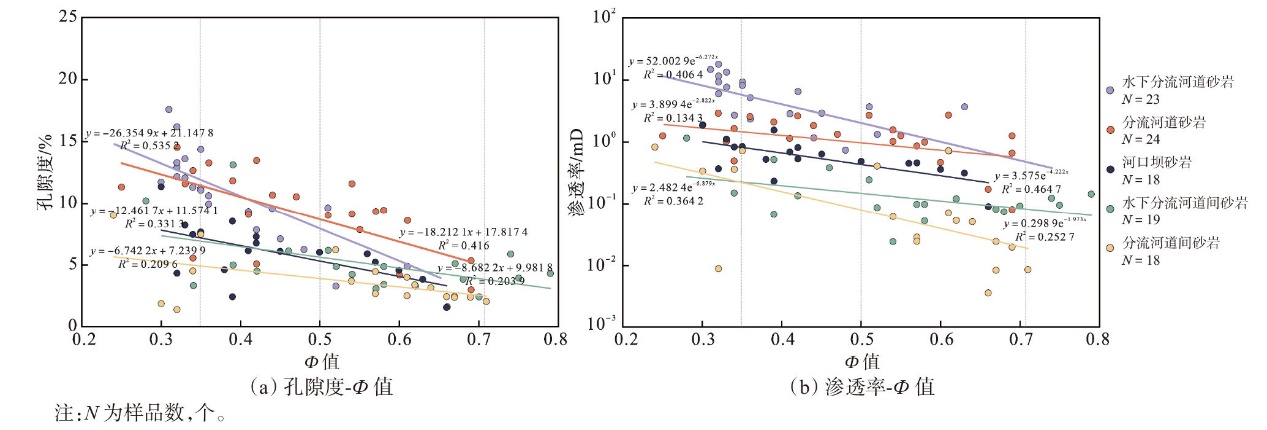
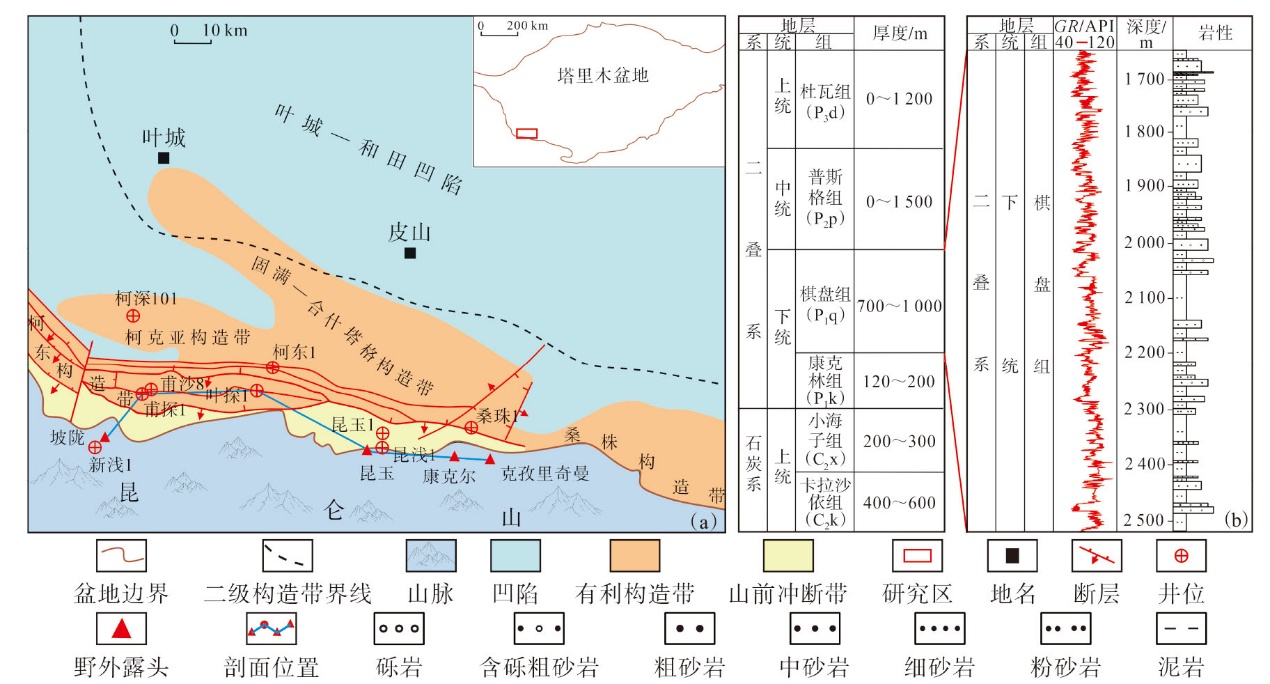
Fig. 1

Tectonic units division of Kekeya structural belt (a) and comprehensive stratigraphic column of Permian-Carboniferous (b), southwestern Tarim Basin"

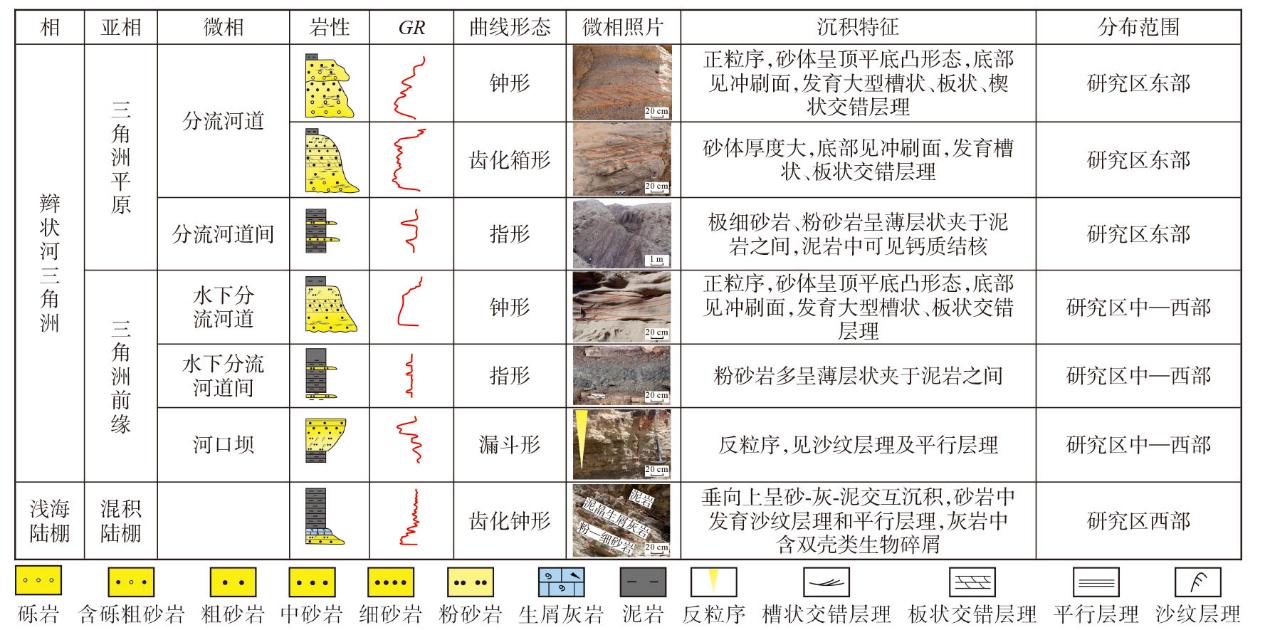
Fig. 2

Sedimentary reservoir characteristics of Qipan Formation in Kekeya structural belt, southwestern Tarim Basin"

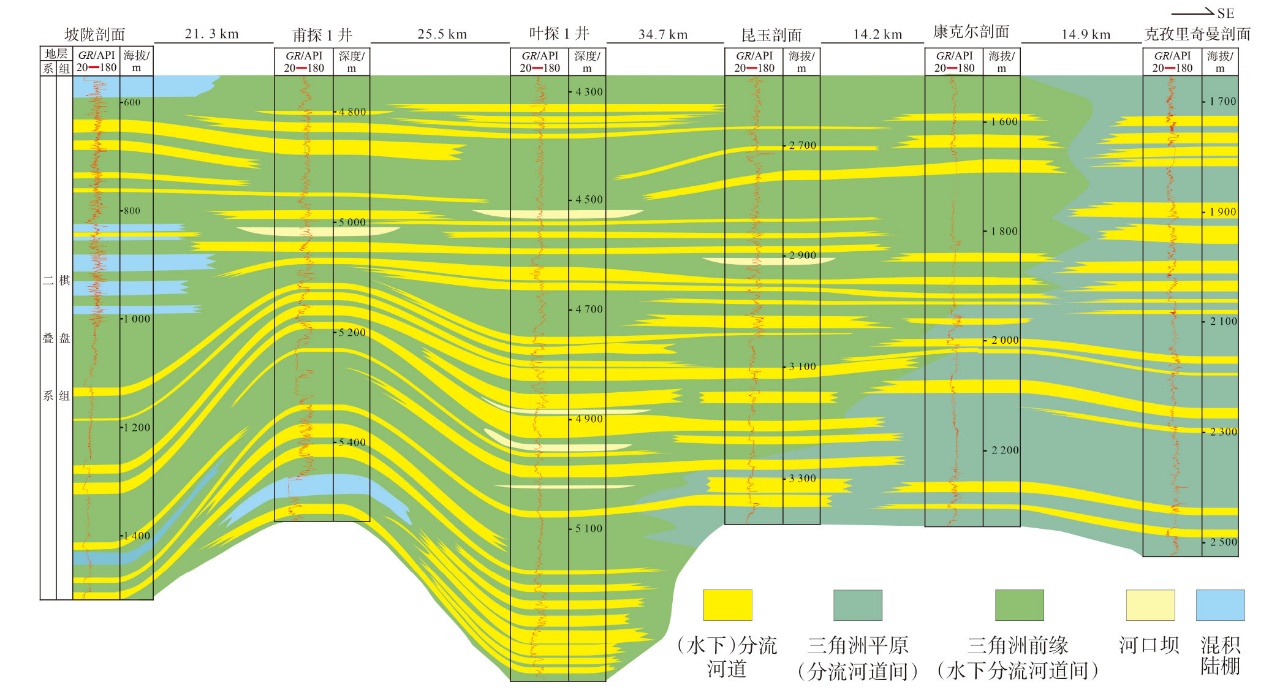
Fig. 3

Well-tie of sedimentary facies of Permian Qipan Formation in Kekeya structural belt, southwestern Tarim Basin"

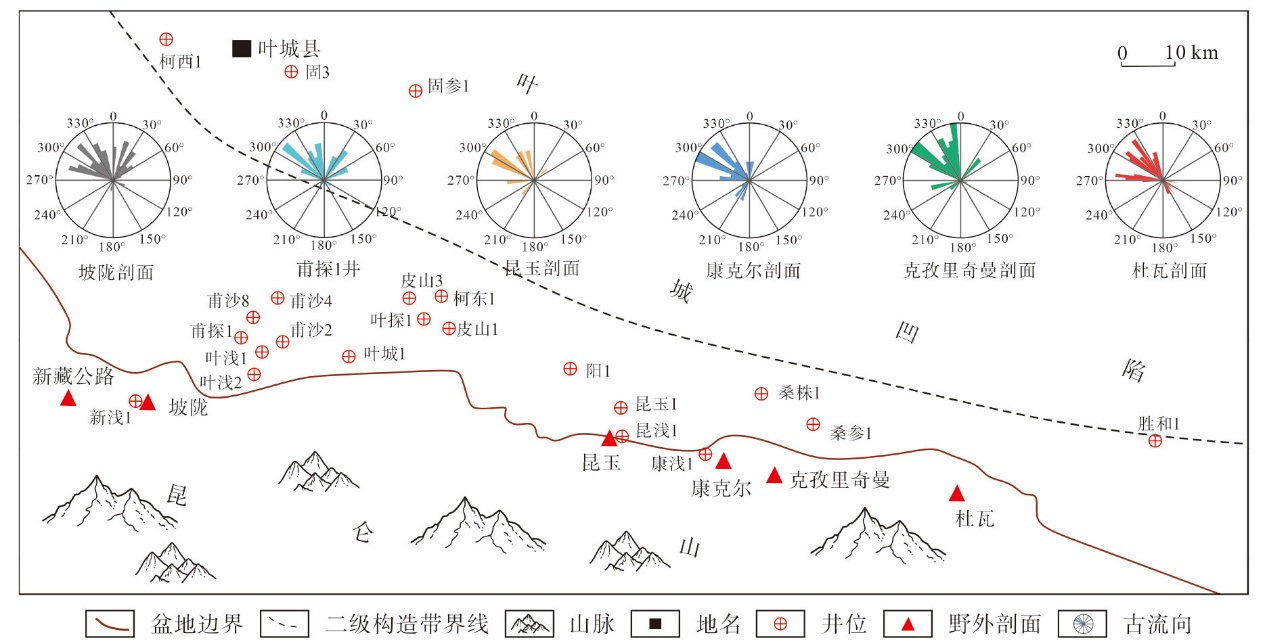
Fig. 4
Paleo-flow direction during the sedimentary period of Permian Qipan Formation in Kekeya structural belt, southwestern Tarim Basin"

Fig. 5

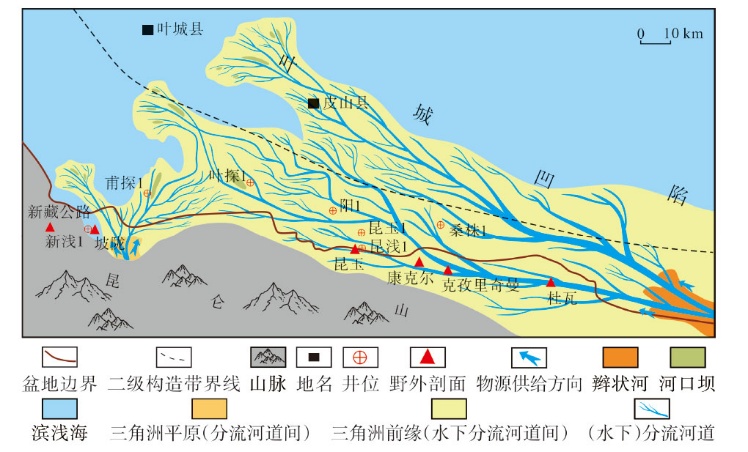
Plane distribution of sedimentary facies of Permian Qipan Formation in Kekeya structural belt, southwestern Tarim Basin"

Fig. 6

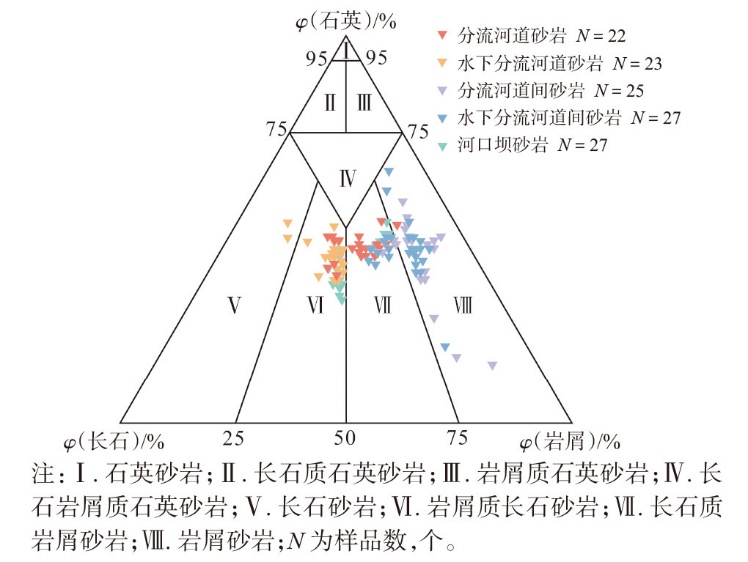
Ternary diagram of mineral composition of reservoirs from different sedimentary microfacies of Permian Qipan Formation in Kekeya structural belt, southwestern Tarim Basin"

Table 1

Comparison of petrology characteristics of reservoirs from different sedimentary microfacies of Permian Qipan Formation in Kekeya structural belt, southwestern Tarim Basin"

沉积微相 ϕ(矿物成分)/% 结构特征
石英 长石 岩屑 粒度 分选系数 磨圆度
水下分流
河道
36.5~52.7/
45.3(23)
26.8~38.9/
30.2(23)
10.5~29.9/
24.5(23)
以细砂为主,体积分数51.0%;
其次为中砂,体积分数25.5%
0.31~0.64/
0.40(20)
以次圆—次棱状为主,数量占比68.2%,其次为次圆状,
数量占比31.8%
分流河道 32.4~52.2/
42.2(27)
14.5~34.8/
19.2(27)
25.5~37.4/
38.6(27)
以中砂为主,体积分数51.0%;
其次为细砂和粗砂,
体积分数39.2%
0.32~0.70/
0.52(31)
以次棱—次圆状为主,数量占比68.2%;其次为次圆—次棱状,数量占比37.2%
河口坝 38.2~51.5/
43.7(22)
12.5~33.8/
31.6(22)
22.5~36.3/
24.7(22)
以粉砂为主,体积分数52.6%;
其次为细砂和极细砂,
体积分数47.4%
0.23~0.63/
0.44(26)
以次圆—次棱状为主,数量占比64.3%;其次为次棱—次圆状,数量占比32.2%
分流
河道间
14.5~53.2/
37.6(25)
4.9~22.8/
12.8(25)
34.3~74.7/
49.6(25)
以粉砂为主,体积分数85.7%;
其次为极细砂,体积分数14.3%)
0.24~0.71/
0.56(30)
以次棱—次圆状为主,数量占比72.5%;其次为次棱状,
数量占比24.8%
水下分流
河道间
19.8~64.2/
40.1(27)
8.4~23.8/
14.7(27)
27.7~62.1/
45.2(27)
以粉砂为主,体积分数70.6%;
其次为极细砂,
体积分数29.4%
0.21~0.68/
0.49(24)
以次棱—次圆状为主,数量占比69.3%;其次为次棱状,
数量占比28.6%

Fig. 7

Physical property characteristics of reservoirs from different sedimentary microfacies of Permian Qipan Formation in Kekeya structural belt, southwestern Tarim Basin"

Table 2

Characteristics of storage space of reservoirs from different sedimentary microfacies of Permian Qipan Formation in Kekeya structural belt, southwestern Tarim Basin"

砂岩类型 孔隙类型占比/% 微裂
缝占比/%
面孔率/%
原生粒间孔 粒间溶孔 粒内溶孔 铸模孔 微孔隙+晶间孔
水下分流
河道砂岩
14.40 70.50 5.03 7.86 0.13 2.08 2.30~10.20/
5.10(31)
分流河道
砂岩
17.47 73.80 4.37 3.60 0.76 0.30~6.30/
3.10(30)
河口坝
砂岩
14.83 75.29 3.78 5.52 0.58 0.40~3.20/
1.60(21)
水下分流
河道间砂岩
10.60 67.55 17.88 1.32 2.65 0.10~1.90/
0.50(30)
分流河道间砂岩 5.13 71.79 20.51 0.86 1.71 0.10~1.70/
0.30(32)

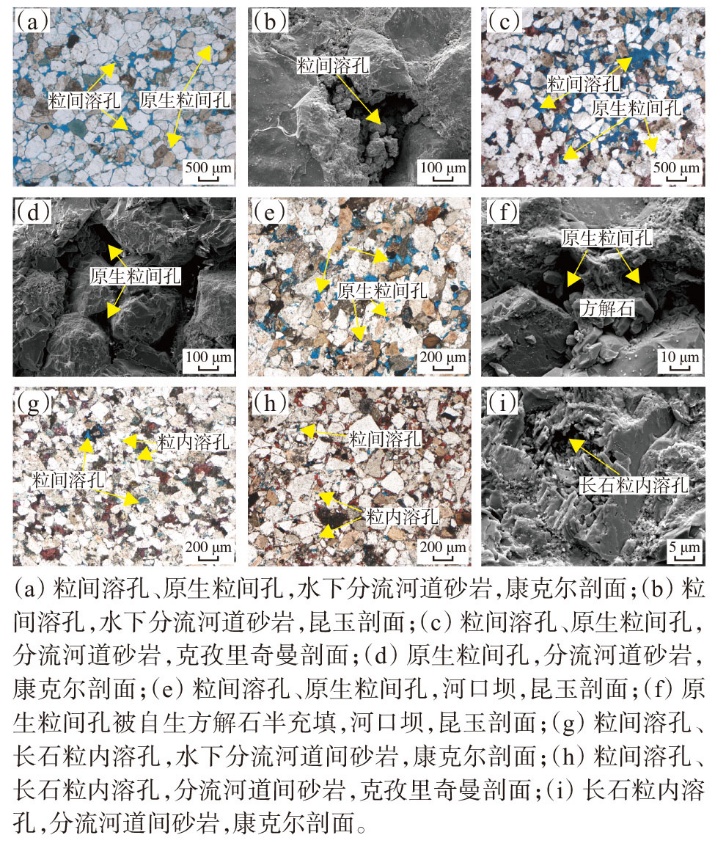
Fig. 8

Microscopic characteristics of reservoir space of Permian Qipan Formation in Kekeya structural belt, southwestern Tarim Basin"

Table 3

Pore structure features of reservoirs from diffe-rent sedimentary microfacies of Permian Qipan Formation in Kekeya structural belt, southwestern Tarim Basin"

沉积
储层
岩石
类型
平均排驱压力/MPa 平均中值压力
/MPa
平均孔喉半径
/μm
平均最大进汞饱和度/% 样品数量/个
水下分流
河道储层
岩屑长石砂岩 0.242 2.628 0.771 87.954 4
分流河道
储层
长石岩屑砂岩 1.540 12.211 0.146 75.052 4
河口坝
储层
岩屑长石砂岩 4.535 33.098 0.058 71.293 3
水下分流
河道间储层
岩屑
砂岩
7.080 115.466 0.057 60.026 3
分流河道间储层 岩屑
砂岩
9.712 103.070 0.020 66.696 3

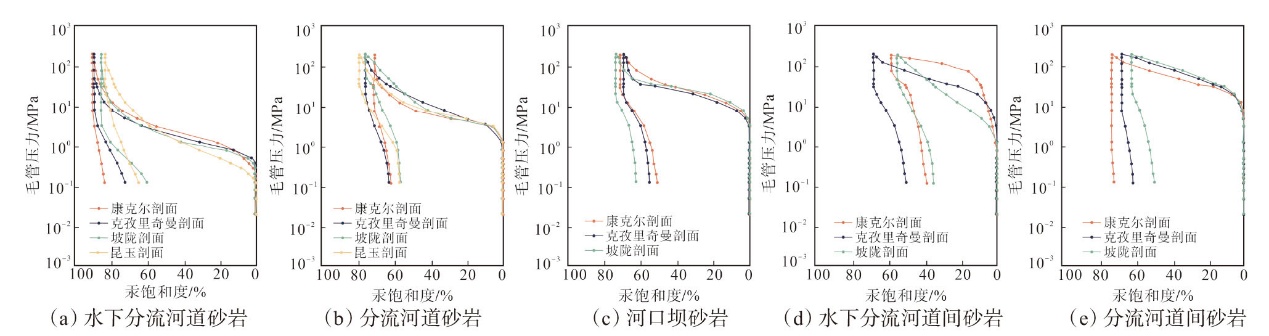
Fig. 9

Mercury intrusion curves of sandstone samples from different sedimentary microfacies of Permian Qipan Formation in Kekeya structural belt, southwestern Tarim Basin"

Table 4

Classification evaluation indicators of reservoirs of Permian Qipan Formation in Kekeya structural belt, southwestern Tarim Basin"

储层
类型
沉积
微相
厚度/
m
孔隙度/% 渗透率/mD 面孔率/% 排驱压力/MPa 孔喉半径/μm
Ⅰ类 水下分流
河道
8.96 10.23 8.35 5.13 0.240 0.770
Ⅱ类 分流河道 4.74 9.00 1.51 3.05 1.540 0.150
河口坝 2.36 6.67 0.89 3.20 4.540 0.060
Ⅲ类 水下分流
河道间
1.18 4.41 0.11 0.50 7.080 0.060
分流
河道间
0.95 3.35 0.09 0.37 9.710 0.020

Fig. 10

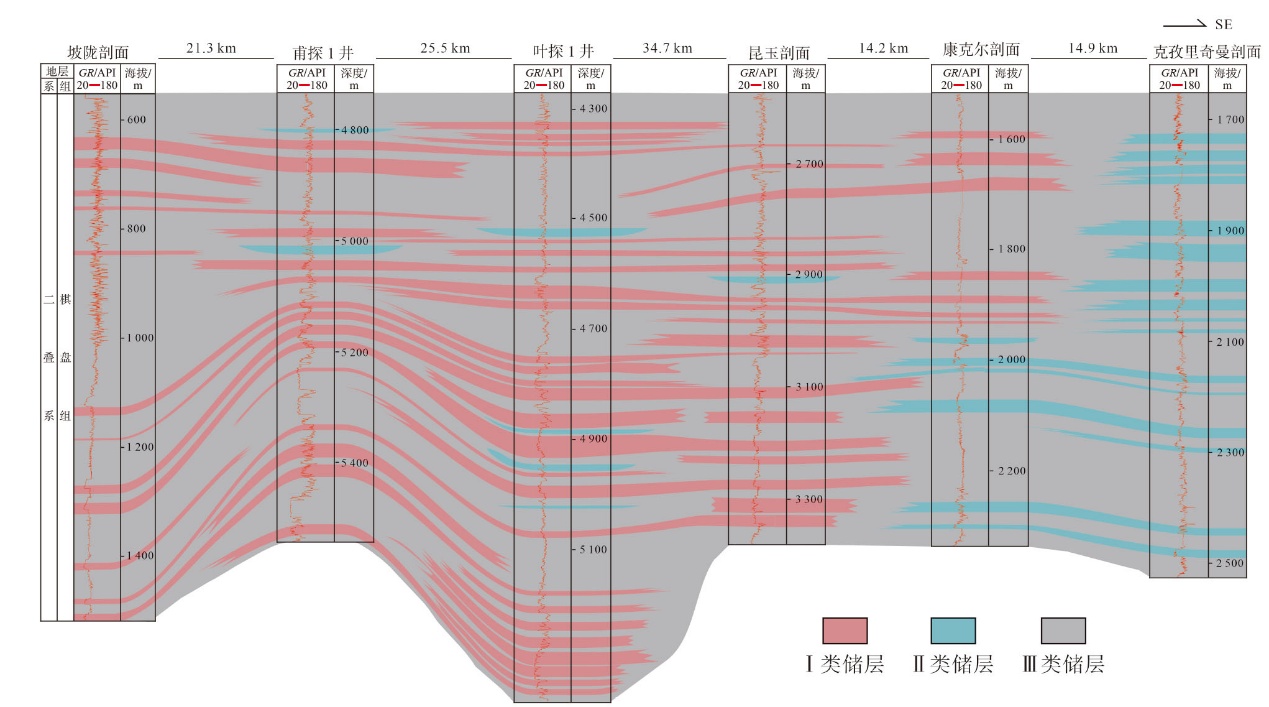
Distribution characteristics of reservoir profiles of Permian Qipan Formation in Kekeya structural belt, southwestern Tarim Basin"

Fig. 11

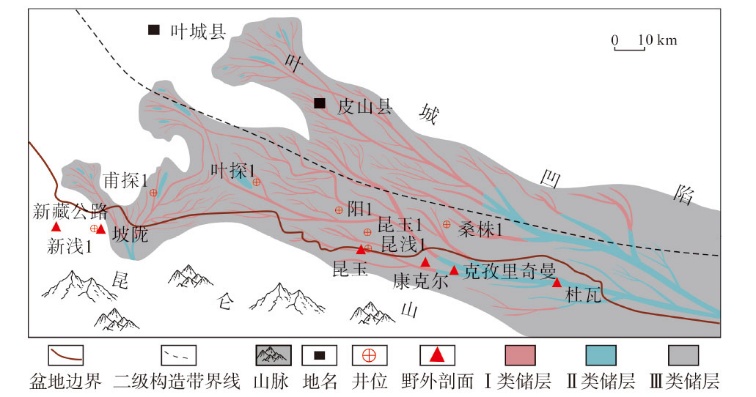
Plane distribution characteristics of reservoir of Permian Qipan Formation in Kekeya structural belt, southwestern Tarim Basin"

Fig. 12

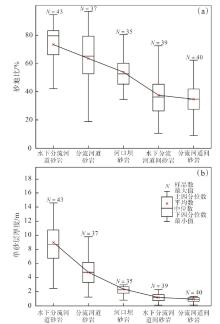
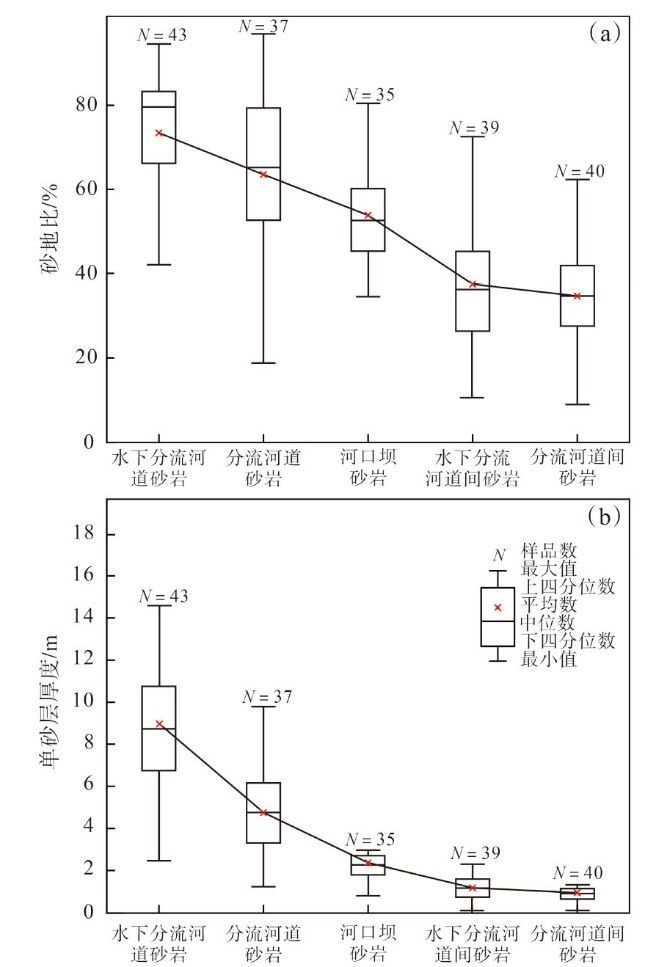
Box plots of sand-stratum ratio (a) and sandstone thickness (b) of reservoirs from different sedimentary microfacies of Permian Qipan Formation in Kekeya structural belt, southwestern Tarim Basin"

Fig. 13

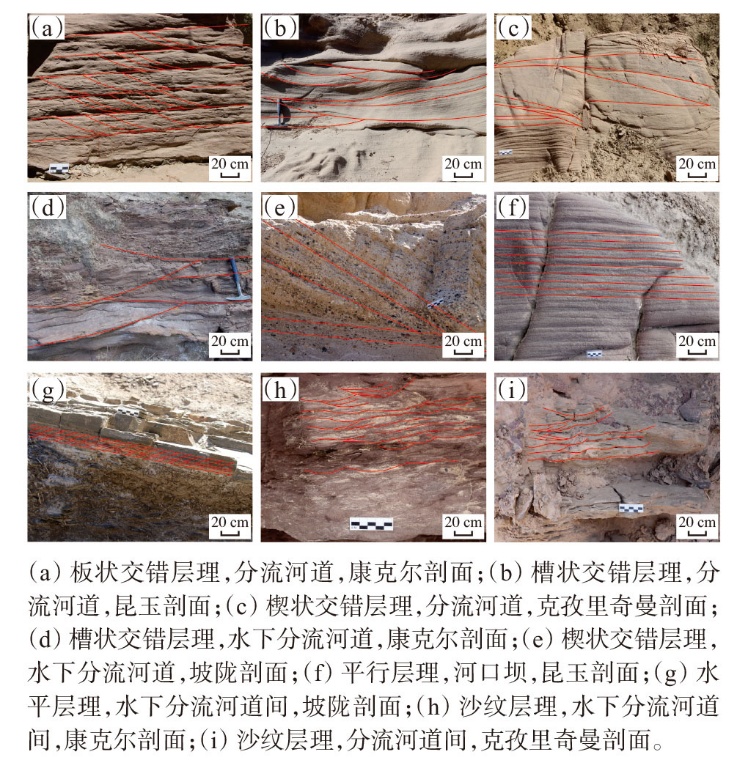
Sedimentary structural characteristics of reservoirs of Permian Qipan Formation of typical sections of Kekeya structural belt, southwestern Tarim Basin"

Fig. 14

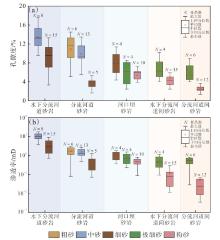
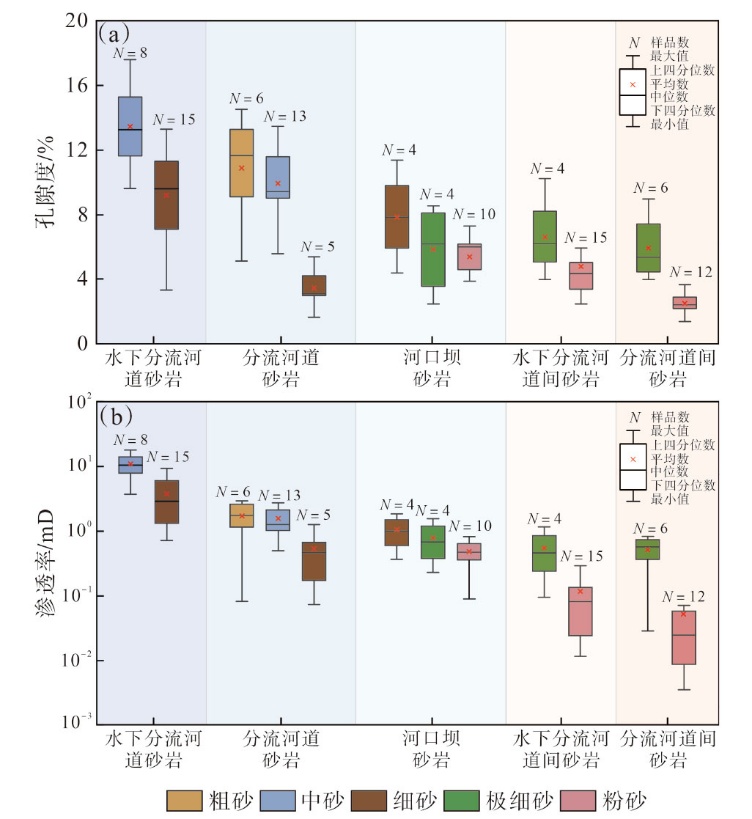
Box plots of porosity (a) and permeability (b) of reservoirs from different sedimentary microfacies of Permian Qipan Formation in Kekeya structural belt, southwestern Tarim Basin"

Fig. 15

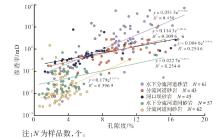
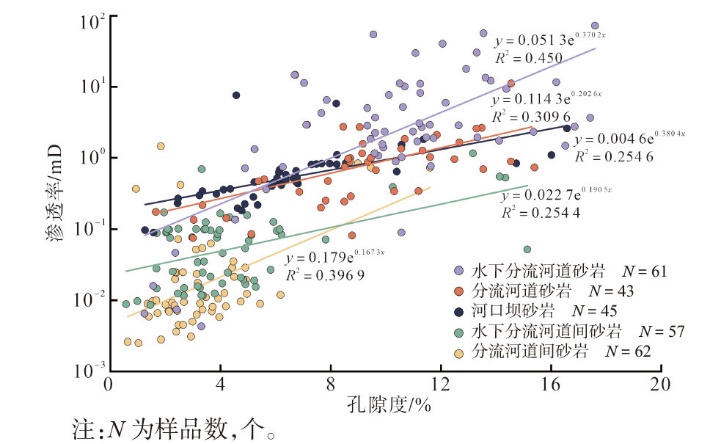
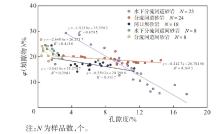
Correlation of porosity and permeability with Ф value of reservoirs from different sedimentary microfacies of Permian Qipan Formation in Kekeya structural belt, southwestern Tarim Basin"

Fig. 16

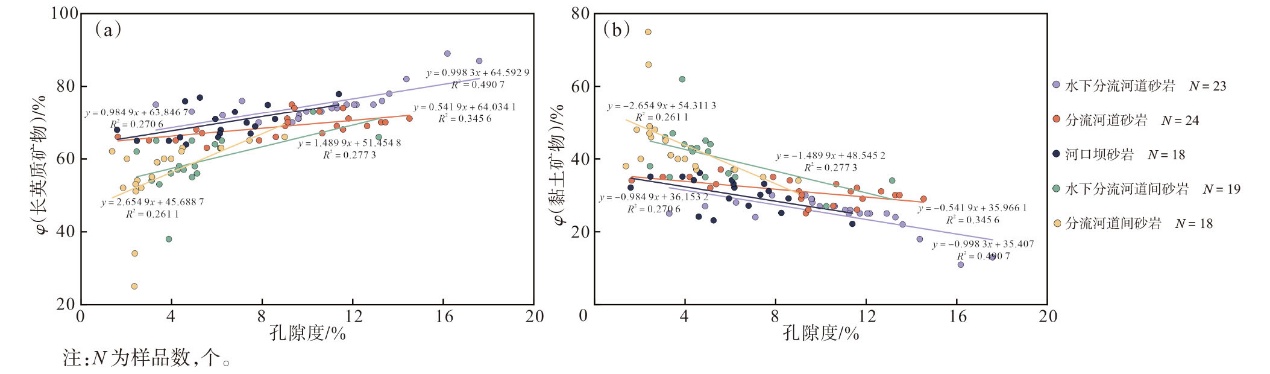
Correlation of felsic mineral content(a) and clay mineral content (b) with porosity of reservoirs from different sedimentary microfacies of Permian Qipan Formation in Kekeya structural belt, southwestern Tarim Basin"

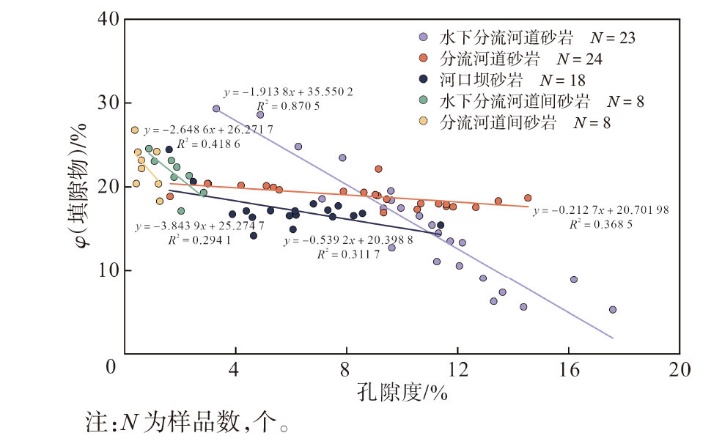
Fig. 17

Correlation between reservoirs interstitial material content and porosity of reservoirs from different sedimentary microfacies of Permian Qipan Formation in Kekeya structural belt, southwestern Tarim Basin"

Table 5

Quantitative calculation formulas for porosity of reservoirs of Permian Qipan Formation in Kekeya structural belt, southwestern Tarim Basin"

孔隙度演化参数 计算公式 符号注解
分选系数 S0=(D25/D75½ D25D75分别为粒度累计频率曲线上25%处、75%处的粒径大小,mm
原始孔隙度 Φ1 = 20.91 +(22.90/S0
压实后剩余孔隙度 Φ2 = PMP1 + P2)/PT + C PM为样品实测孔隙度,%;P1P2PT分别为剩余粒间孔面孔率、胶结物
溶蚀面孔率、总面孔率,%;C为胶结物质量分数,%
压实作用损失孔隙度 Φ3 = Φ1-Φ2
压实作用孔隙度损失率 F1 = Φ3/Φ1×100%
压实-胶结后剩余孔隙度 Φ4 = PMP1/PT
胶结作用损失孔隙度 Φ5 = Φ2-Φ4
胶结作用孔隙度损失率 F2 = Φ5/Φ1×100%
溶蚀作用增加孔隙度 Φ6 = PMP3/PT P3为溶蚀孔面孔率,%

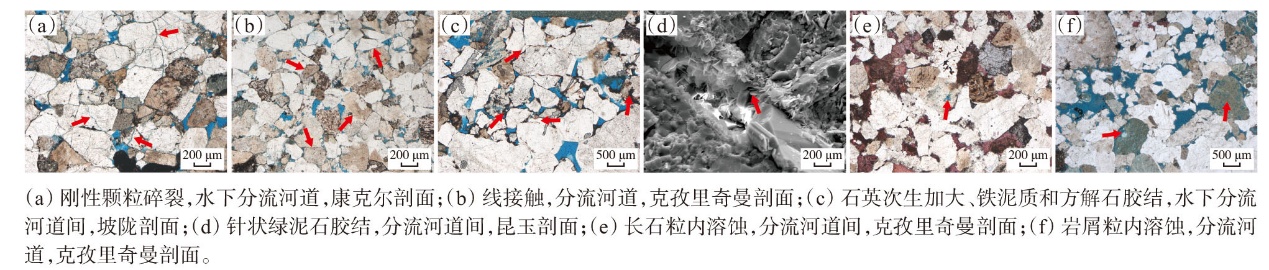
Fig. 18

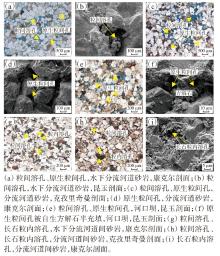
Characteristics of diagenesis in rock thin sections of reservoirs from different sedimentary microfacies of Permian Qipan Formation in Kekeya structural belt, southwestern Tarim Basin"

Table 6

Diagenesis parameters of reservoirs from different sedimentary microfacies of Permian Qipan Formation in Kekeya structural belt, southwestern Tarim Basin"

沉积储层 原始孔隙度/% 压实后孔隙度/% 压实减孔率/% 视压实率/% 胶结后孔隙度/% 胶结减孔率/% 视胶结率/% 溶蚀增孔率/%
水下分流
河道储层
32.12~39.14
(35.05)
10.68~18.09
(14.14)
15.87~23.09(20.91) 46.73~67.19
(59.68)
1.14~15.86
(8.92)
2.05~9.55
(5.21)
5.24~29.32
(15.1)
1.08~2.30
(1.76)
分流河道
储层
37.43~68.69
(58.16)
7.49~25.76
(18.79)
28.73~47.90
(40.21)
61.99~80.43
(68.73)
1.02~13.01
(7.66)
6.47~14.28
(11.13)
16.89~22.09
(18.81)
0.61~1.78
(1.13)
河口坝储层 16.12~31.78
(26.57)
4.13~14.67
(9.05)
11.99~20.12
(17.52)
53.19~74.35
(66.55)
0.20~9.86
(4.56)
3.22~5.39
(4.49)
14.09~24.39
(17.15)
1.12~1.67
(1.47)
水下分流
河道间储层
15.23~25.63
(20.18)
3.39~7.55
(5.37)
11.44~18.08
(14.81)
69.56~82.36
(73.54)
0.10~2.01
(1.00)
3.29~6.30
(4.37)
17.11~24.58
(21.51)
0.69~0.91
(0.79)
分流河道间
储层
15.32~27.41
(22.57)
3.00~7.49
(5.49)
12.32~20.08
(17.08)
72.63~80.41
(75.98)
0.03~0.99
(0.39)
2.79~6.60
(5.10)
18.23~26.74
(22.41)
0.21~0.45
(0.35)

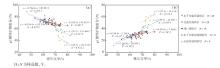
Fig. 19

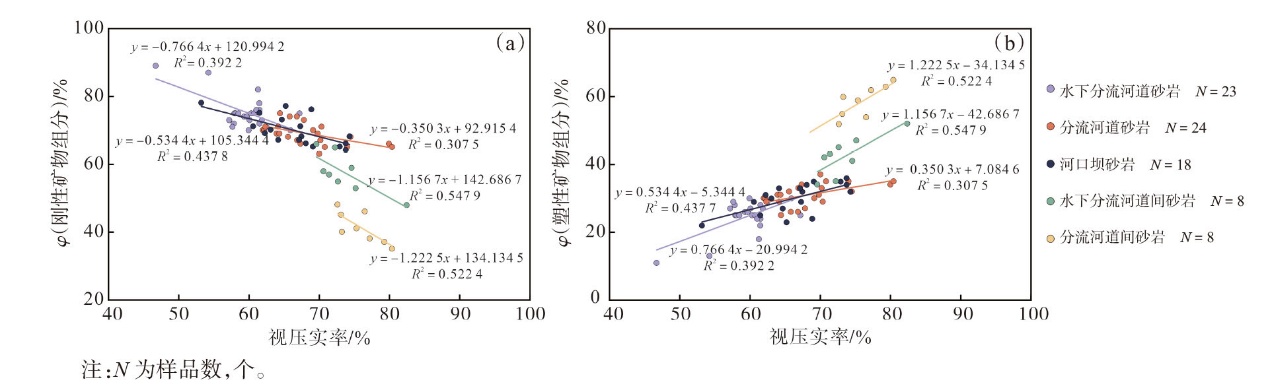
Correlation of rigid mineral composition content (a) and ductile mineral composition content (b) with apparent compaction rate of reservoirs from different sedimentary microfacies of Permian Qipan Formation in Kekeya structural belt, southwestern Tarim Basin"

[1] 胡剑风, 郑多明, 胡轩, 等. 塔西南前陆盆地战略接替区天然气勘探的突破[J]. 中国石油勘探, 2002, 7(1):74-78.
HU Jianfeng, ZHENG Duoming, HU Xuan, et al. Breakthrough of gas exploration in southwest Tarim Foreland Basin:The strategic replacement area of CNPC and TOC[J]. China Petroleum Exploration, 2002, 7(1):74-78.
[2] 何登发, 李德生, 何金有, 等. 塔里木盆地库车坳陷和塔西南坳陷油气地质特征类比及勘探启示[J]. 石油学报, 2013, 34(2):201-218.
HE Dengfa, LI Desheng, HE Jinyou, et al. Comparison in petroleum geology between Kuqa Depression and Southwest Depression in Tarim Basin and its exploration significance[J]. Acta Petrolei Sinica, 2013, 34(2):201-218.
[3] 金玉洁, 王雷, 庞雄奇, 等. 塔里木盆地西南坳陷全油气系统多源复合成藏特征与有序分布模式[J]. 石油与天然气地质, 2025, 46(4):1316-1332
JIN Yujie, WANG Lei, PANG Xiongqi, et al. Multi-sourced composite hydrocarbon accumulation and ordered distribution pattern of the whole petroleum system in the Southwestern Depression,Tarim Basin[J]. Oil & Gas Geology, 2025, 46(4):1316-1332.
[4] 孙春燕, 索义虎, 罗强, 等. 不同母岩性质砂岩储集层特征及差异研究:以塔西南山前下侏罗统为例[J]. 古地理学报, 2026, 28(1):290-303.
SUN Chunyan, SUO Yihu, LUO Qiang, et al. Study on characteristics and differences of sandstone reservoirs with different source rock properties:An example from the Lower Jurassic in the piedmont area of southwestern Tarim Basin[J]. Journal of Palaeogeography (Chinese Edition), 2026, 28(1):290-303.
[5] 徐雄飞, 王嘉伟, 杨波, 等. 塔里木盆地轮南地区侏罗系砂岩储层成岩作用研究[J]. 岩性油气藏, 2011, 23(5):21-27.
XU Xiongfei, WANG Jiawei, YANG Bo, et al. Study on diage-nesis of Jurassic sandstone reservoirs in Lunnan area,Tarim Basin[J]. Lithologic Reservoirs, 2011, 23(5):21-27.
[6] 郑兴平, 潘文庆, 常少英, 等. 塔里木盆地奥陶系台缘类型及其储层发育程度的差异性[J]. 岩性油气藏, 2011, 23(5):1-4.
ZHENG Xingping, PAN Wenqing, CHANG Shaoying, et al. Relationship between Ordovician platform margin types and reef-shoal reservoirs in Tarim Basin[J]. Lithologic Reservoirs, 2011, 23(5):1-4.
[7] 侯啓东, 任收麦, 郭天旭, 等. 塔里木盆地西南坳陷二叠系页岩油气地质条件分析[J]. 西北地质, 2020, 53(1):168-177.
HOU Qidong, REN Shoumai, GUO Tianxu, et al. Analysis of geological conditions of Permian shale oil and gas in the Southwestern Depression of the Tarim Basin,Northwest China[J]. Northwestern Geology, 2020, 53(1):168-177.
[8] 巩高阳, 张尚锋, 罗顺社, 等. 塔里木盆地西南缘生物礁特征:以阿尔塔什剖面石炭系和什拉甫组为例[J]. 海洋地质前沿, 2023, 39(4):66-75.
GONG Gaoyang, ZHANG Shangfeng, LUO Shunshe, et al. Characteristics of Carboniferous reef in Heshlafu Formation at Altash section in the southwestern margin of Tarim Basin[J]. Marine Geology Frontiers, 2023, 39(4):66-75.
[9] 杜治利, 曾昌民, 邱海峻, 等. 塔西南叶城凹陷二叠系两套烃源岩特征及柯东1井油源分析[J]. 吉林大学学报(地球科学版), 2016, 46(3):651-660.
DU Zhili, ZENG Changmin, QIU Haijun, et al. Key formationsof the Permian hydrocarbon source rocks and oil-source correlation of well KD1 inYecheng Depression of southwestern Tarim Basin[J]. Journal of Jilin University (Earth Science Edition), 2016, 46(3):651-660.
[10] 王清华, 徐振平, 张荣虎, 等. 塔里木盆地油气勘探新领域、新类型及资源潜力[J]. 石油学报, 2024, 45(1):15-32.
WANG Qinghua, XU Zhenping, ZHANG Ronghu, et al. New fields,new types of hydrocarbon exploration and their resource potentials in Tarim Basin[J]. Acta Petrolei Sinica, 2024, 45(1):15-32.
[11] 王清华, 杨海军, 李勇, 等. 塔西南山前地区恰探1井石炭系—二叠系重大突破与勘探前景[J]. 中国石油勘探, 2023, 28(4):34-45.
WANG Qinghua, YANG Haijun, LI Yong, et al. Major breakthrough in the Carboniferous-Permian in Well Qiatan 1 and exploration prospect in the piedmont southwestern Tarim Basin[J]. China Petroleum Exploration, 2023, 28(4):34-45.
[12] 黄礼, 赵颖, 吕惠贤, 等. 塔里木盆地西南山前坳陷恰探1井二叠系天然气成因和来源[J]. 石油实验地质, 2024, 46(6):1286-1297.
HUANG Li, ZHAO Yin, LYU Huixian, et al. Genesis and source of Permian natural gas in well Qiatan-1 of piedmont depression,southwestern Tarim Basin[J]. Petroleum Geology & Experiment, 2024, 46(6):1286-1297.
[13] 王清华, 杨海军, 李勇, 等. 塔西南山前地区柯克亚构造带叶探1井油气勘探重大突破及意义[J]. 中国石油勘探, 2024, 29(4):1-16.
WANG Qinghua, YANG Haijun, LI Yong, et al. Major oil and gas discovery and significance of Well Yetan 1 in the peripheral Kekeya area in the piedmont of the southwestern Tarim Basin[J]. China Petroleum Exploration, 2024, 29(4):1-16.
[14] 杨海军, 孙迪, 邱斌, 等. 塔西南山前地区柯东构造带杜瓦1井二叠系油气勘探突破及意义[J]. 石油学报, 2025, 46(11):2013-2033.
YANG Haijun, SUN Di, QIU Bin, et al. Breakthrough and significance of Permian oil and gas exploration in Well Duwa 1 of Kedong structural belt in the southwestern piedmont of Tarim Basin[J]. Acta Petrolei Sinica, 2025, 46(11):2013-2033.
[15] 陈叔阳, 何云峰, 王立鑫, 等. 塔里木盆地顺北1号断裂带奥陶系碳酸盐岩储层结构表征及三维地质建模[J]. 岩性油气藏, 2024, 36(2):124-135.
CHEN Shuyang, HE Yunfeng, WANG Lixin, et al. Architecture characterization and 3D geological modeling of Ordovician carbonate reservoirs in Shunbei No. 1 fault zone,Tarim Basin[J]. Lithologic Reservoirs, 2024, 36(2):124-135.
[16] 韩睿, 张尚锋, 罗顺社, 等. 碎屑岩与碳酸盐岩混合沉积模式:以新疆塔西南地区上石炭统卡拉乌依组为例[J]. 断块油气田, 2023, 30(2):269-276.
HAN Rui, ZHANG Shangfeng, LUO Shunshe, et al. Mixed sedimentary model of clastic rocks and carbonate rocks:A case study of Karawuyi Formation of Upper Carboniferous in southwest Tarim,Xinjiang[J]. Fault-Block Oil & Gas Field, 2023, 30(2):269-276.
[17] 王翼君, 杨光, 王振宇, 等. 塔西南阿尔塔什剖面下石炭统和什拉甫组生物礁地质特征[J]. 地质科技通报, 2024, 43(2):99-110.
WANG Yijun, YANG Guang, WANG Zhenyu, et al. Geological characteristics of the Lower Carboniferous Heshirafu Formation reef in the Artashi section in the southwest Tarim Basin[J]. Bulletin of Geological Science and Technology, 2024, 43(2):99-110.
[18] 黎文杰, 王振宇. 塔西南山前地区艾特沟剖面棋盘组沉积及演化特征[J]. 地质学刊, 2025, 49(2):164-173.
LI Wenjie, WANG Zhenyu. Sedimentary and evolutionary cha-racteristics of the Qipan Formation in Aitegou Section,in the piedmont area of the southwestern Tarim Basin[J]. Journal of Geology, 2025, 49(2):164-173.
[19] 谢小敏, 胡旭, 王张虎, 等. 塔西南地区齐美干剖面二叠系两套烃源岩地球化学特征[J]. 长江大学学报(自然科学版), 2025, 22(4):1-11.
XIE Xiaomin, HU Xu, WANG Zhanghu, et al. Geochemical characteristics of two sets of Permian source rocks in the Qimei Dry Section of the southwestern Tarim Basin[J]. Journal of Yangtze University (Natural Science Edition), 2025, 22(4):1-11.
[20] WANG Jingbin, HE Zhiliang, ZHU Dongya, et al. Organici-norganic geochemical characteristics of the Upper Permian Pusige Formation in a high-saline lake basin,Tarim Basin:Implications for provenance,paleoenvironments,and organic matter enrichment[J]. Geofluids, 2021(6):1-26.
[21] GAO Xiaojie, XIAO Qilin, GE Zhushi, et al. Molecular and carbon isotopic compositions of crude oils from the Kekeya area of the southwest depression,Tarim Basin:Implications for oil groups and effective sources[J]. Energies. 2024, 17(3):760.
[22] ZHOU Jian, ZHANG Kuihua, ZHANG Guanlong, et al. Chemostratigraphy of the Permian Fengcheng Formation shale from well HS-1 in the Hala’alat Mountain area,northwestern Junggar Basin:Implications for hydrocarbon generation potential,palaeoenvironmental conditions and organic matter accumulation[J]. Geological Journal, 2026, 61(4):1014-1028.
[23] 陈才, 邓琳, 罗强, 等. 塔西南叶浅1井二叠系普斯格组烃源岩分段性发育特征[J]. 地球化学, 2025, 54(3):326-335.
CHEN Cai, DENG Lin, LUO Qiang, et al. Heterogeneous deve-lopment characteristics of the Permian Pusige Formation in well Yeqian 1,southwestern Tarim Basin[J]. Geochimica, 2025, 54(3):326-335.
[24] 孟苗苗, 康志宏, 邱海峻, 等. 塔西南坳陷二叠系烃源岩控制因素探讨[J]. 矿物岩石地球化学通报, 2016, 35(2):344-352.
MENG Miaomiao, KANG Zhihong, QIU Haijun, et al. Controlling factors of Permian hydrocarbon source rocks in the southwest depression of Tarim Basin[J]. Bulletin of Mineralogy,Petrology and Geochemistry, 2016, 35(2):344-352.
[25] 徐思慧, 赵军, 赵新建, 等. 库车山前克拉苏构造带白垩系亚格列木组致密储层裂缝有效性评价[J]. 岩性油气藏, 2025, 37(5):155-165.
XU Sihui, ZHAO Jun, ZHAO Xinjian, et al. Fracture effectiveness evaluation of tight reservoir of Cretaceous Yageliemu Formation in Kelasu structural belt,Kuqa piedmont[J]. Lithologic Reservoirs, 2025, 37(5):155-165.
[26] 韩慧宇, 康志宏, 邓鹏, 等. 塔西南坳陷棋盘组沉积特征综合分析[J]. 煤炭技术, 2018, 37(1):122-124.
HAN Huiyu, KANG Zhihong, DENG Peng, et al. Comprehensive analysis of sedimentary characteristics of Qipan Formation in southwest margin of Tarim Basin[J]. Coal Technology, 2018, 37(1):122-124.
[27] 孟苗苗, 康志宏, 樊太亮, 等. 痕量元素和碳氧同位素在塔里木盆地西南缘棋盘组沉积环境研究中的应用[J]. 成都理工大学学报(自然科学版), 2016, 43(1):77-85.
MENG Miaomiao, KANG Zhihong, FAN Tianliang, et al. Application of trace elements and carbon-oxygen isotopes on the research of sedimentary environment of the Qipan Formation in the southwest margin of Tarim Basin,China[J]. Journal of Chengdu University of Technology (Science & Technology Edition), 2016, 43(1):77-85.
[28] 易珍丽, 石放, 尹太举, 等. 塔里木盆地哈拉哈塘—哈得地区中生界物源转换及沉积充填响应[J]. 岩性油气藏, 2024, 36(5):56-66.
YI Zhenli, SHI Fang, YIN Taiju, et al. Provenance transformation and sedimentary filling response of Mesozoic in Halahatang-Hade area,Tarim Basin[J]. Lithologic Reservoirs, 2024, 36(5):56-66.
[29] 张涵冰, 彭军, 杨素举, 等. 致密砂岩储层成岩作用及其控制因素分析:以塔里木盆地顺托果勒地区志留系柯坪塔格组下段为例[J]. 石油实验地质, 2016, 38(4):543-550.
ZHANG Hanbing, PENG Jun, YANG Suju, et al. Diagenesis and controlling factors of tight sandstone reservoirs:A case study of the lower member of Silurian Kepingtage Formation in Shuntuoguole area,Tarim Basin[J]. Petroleum Geology & Experiment, 2016, 38(4):543-550.
[30] 李锟, 于炳松, 王黎栋, 等. 塔里木盆地东南地区侏罗系低孔渗砂岩储层成岩作用及孔隙演化[J]. 现代地质, 2014, 28(2):388-395.
LI Kun, YU Bingsong, WANG Lidong, et al. Diagenesis and pore evolution of Jurassic low-porosity and low-permeability sandstone reservoir in southeastern Tarim Basin[J]. Geoscience, 2014, 28(2):388-395.
[31] 孟万斌, 肖春晖, 冯明石, 等. 碳酸盐岩成岩作用及其对储层的影响:以塔中顺南地区一间房组为例[J]. 岩性油气藏, 2016, 28(5):26-33.
MENG Wanbin, XIAO Chunhui, FENG Mingshi, et al. Carbonate diagenesis and its influence on reservoir:A case study from Yijianfang Formation in Shunnan area,central Tarim Basin[J]. Lithologic Reservoirs, 2016, 28(5):26-33.
[1] ZHANG Yuqing, ZHAO Zhongxiang, WANG Wei, HE Youbin, LUO Jinxiong, HU Mingyi, YANG Xingyu, WU Lianhua. Sedimentary characteristics and controlling factors of carbonate-evaporite rocks in Triassic Jialingjiang Formation, southeastern Sichuan Basin [J]. Lithologic Reservoirs, 2026, 38(4): 101-114.
[2] WANG Zheng, XU Shoucheng, HU Xiuquan, LING Hang, TU Wenmao, ZHOU Yue, ZHANG Xiaoqing, SUN Wenna. Sedimentary models and fine characterization of subtle organic reefs in Permian Changxing Formation, Yuanba area, Sichuan Basin [J]. Lithologic Reservoirs, 2026, 38(4): 12-22.
[3] WANG Yanjun, BIAN Baoli, XIANG Hui, ZHANG Yongjun, SUN Yongxing, XU Xuelong, MA Delong, LI Yun. Reconstruction and petroleum exploration potential of the Permian prototype basin in the periphery of Fukang fault zone, Junggar Basin [J]. Lithologic Reservoirs, 2026, 38(4): 126-136.
[4] XU Zhongfan, DING Xiong, YIN Hong, TIAN Yunying, SONG Yi, YANG Xiran. Reservoir characteristics and main controlling factors of Upper Triassic Xujiahe Formation in Shuangyushi area, northwestern Sichuan Basin [J]. Lithologic Reservoirs, 2026, 38(3): 107-119.
[5] NIE Minglong, LIU Haoyuan, WANG Zhaoming, ZHAO Shumao, YU Taiji. Characteristics, enrichment conditions and exploration implications of helium-rich gas reservoirs in Chu-Sarysu Basin, Kazakhstan [J]. Lithologic Reservoirs, 2026, 38(3): 162-172.
[6] CHEN Xuan, HAO Bin, GOU Hongguang, ZHANG Jing, XU Xiongfei, YANG Zhanlong, HU Jun, HE Changsong. Stratigraphic division of Permian and its exploration significance of Bogda piedmont, northern margin of Tuha Basin [J]. Lithologic Reservoirs, 2026, 38(3): 24-37.
[7] ZHAN Wangzhong, SUI Boyu, WANG Zhongwei, HUO Fei, QI Jun, XIE Shangke, ZENG Shengqiang, HOU Qian. Sedimentary characteristics and reservoir evaluation of Jurassic Quemocuo Formation in Maqu area, eastern part of North Qiangtang Depression [J]. Lithologic Reservoirs, 2026, 38(2): 162-177.
[8] XIAO Fuqiang, XIAO Weidong, JIANG Zhidong, GAO Lei, ZHAO Zhengwei, PAN Xiaofei, CHEN Fugui, ZOU Yongjun. Coal measure shale reservoir characteristics and exploration potential of Permian Leping Formation in Pingle Depression of Lower Yangtze region [J]. Lithologic Reservoirs, 2026, 38(1): 100-114.
[9] XUN Xiaoquan, LI Hongtao, LI Changping, YANG Fan, LIU Xiong. A new method for splitting the production of fractured horizontal wells in strong heterogeneous gas reservoirs:Taking Permian He1 member gas reservoir in Dongsheng Gasfield of Ordos Basin as an example [J]. Lithologic Reservoirs, 2026, 38(1): 191-200.
[10] YAO Jiayu, CAO Wenjie, WANG Wenqiang, MAO Lixin, LUO Bin. Geological condition for coalbed methane accumulation of Permian Longtan Formation in the central part of Northwest Guizhou [J]. Lithologic Reservoirs, 2026, 38(1): 67-77.
[11] LIU Guanbo, CHEN Shijia, LI Shihong, ZOU Yang, LI Yong. Gas generation potential and reservoir formation condition of Permian Fengcheng Formation source rock in Mazhong structural belt of Mahu Sag [J]. Lithologic Reservoirs, 2025, 37(5): 83-96.
[12] YE Hui, ZHU Feng, WANG Guizhong, SHI Wanzhong, KANG Xiaoning, DONG Guoning, Naziyiman, WANG Ren. Paleogeomorphy restoration of Permian-Jurassic and its hydrocarbon implications in Junggar Basin,NW China [J]. Lithologic Reservoirs, 2025, 37(5): 122-132.
[13] ZHAN Lin, FAN Cunhui, TANG Wen, YANG Xiyan, LIU Dongxi, LI Bo, YANG Xinrui. Structural characteristics of Permian Wujiaping Formation,Nanya area, eastern Sichuan Basin and their hydrocarbon reservoir control mechanism [J]. Lithologic Reservoirs, 2025, 37(5): 133-144.
[14] WANG Qing, TIAN Chong, LUO Chao, ZHANG Jingyuan, YANG Xue, WU Wei, TAO Xiayan. Characteristics and exploration prospects of coal-rock gas reservoirs in Permian Longtan Formation in Suining-Hejiang area,Sichuan Basin [J]. Lithologic Reservoirs, 2025, 37(4): 26-37.
[15] WANG Jingzhao, JIN Wei, CHANG Lipeng, DONG Zhongliang, WANG Gaowen. Characteristics and hydrocarbon accumulation process of karst reservoir in the third member of Permian Maokou Formation,Hechuan-Tongnan area,central Sichuan Basin [J]. Lithologic Reservoirs, 2025, 37(4): 63-72.
Viewed
Full text


Abstract

Cited

  Shared   
  Discussed   
No Suggested Reading articles found!
TRENDMD: