岩性油气藏 ›› 2026, Vol. 38 ›› Issue (3): 132–140.doi: 10.12108/yxyqc.20260311
基于GPU加速的SSA三维微地震实时定位方法及应用
曹立斌1( ), 郑马嘉2,3, 陈倩1, 伍亚2, 程利敏1
- 1
成都博赫科技有限公司 成都 610213
2中国石油西南油气田公司 开发事业部 成都 610051
3中国石油勘探开发研究院 北京 100083
GPU-accelerated source scanning algorithm for real-time 3D microseismic monitoring and its application
CAO Libin1(), ZHENG Majia2,3, CHEN Qian1, WU Ya2, CHENG Limin1
- 1
Chengdu Bohe Technology Co. ,Ltd. Chengdu 610213, China
2Development Department ,PetroChina Southwest Oil & Gasfield Company Chengdu 610051, China
3Research Institute of Petroleum Exploration and Development ,CNPC Beijing 100083, China
摘要:
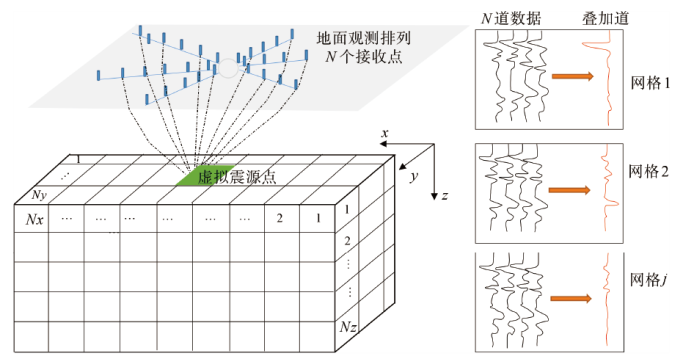
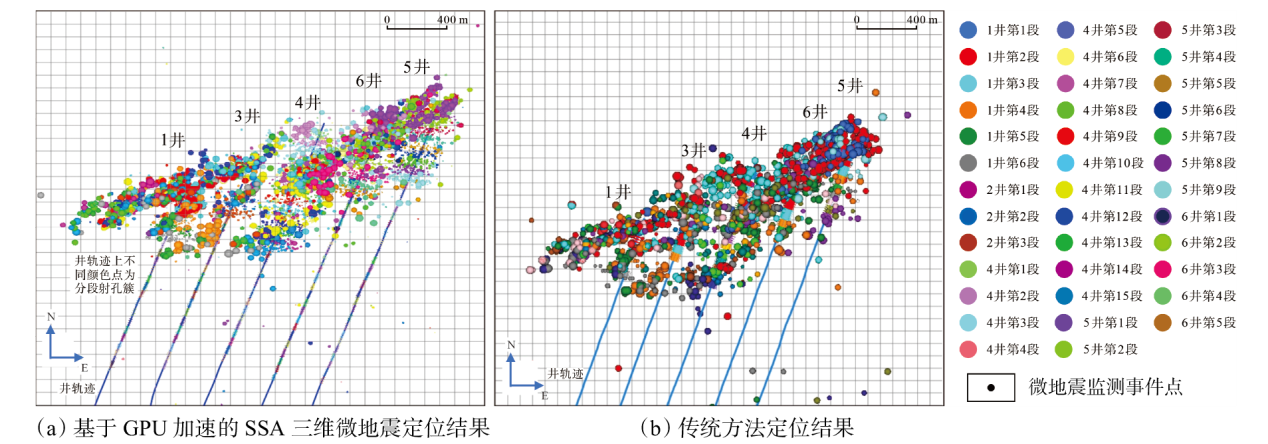
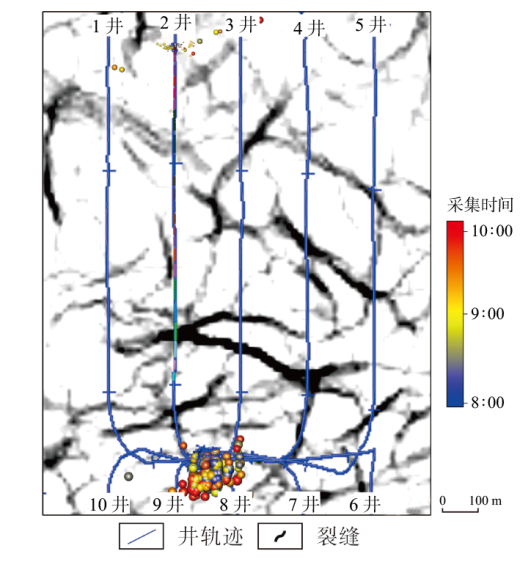
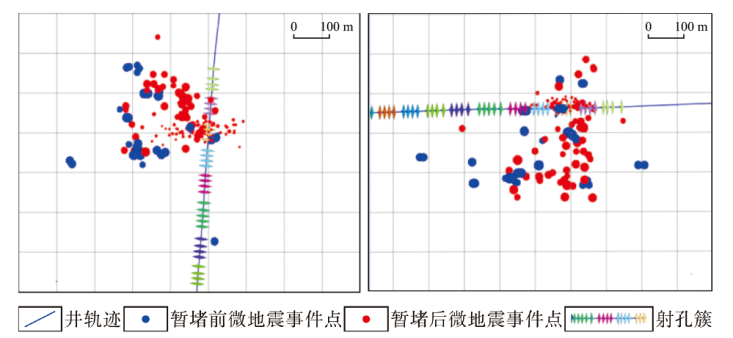
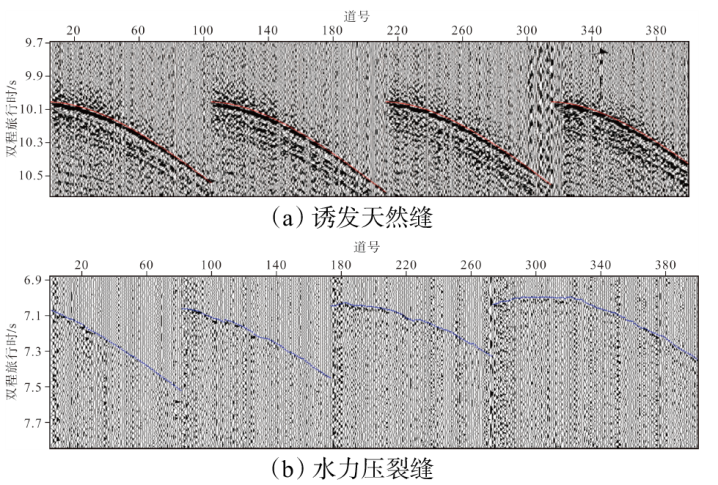
针对微地震监测技术在页岩气压裂改造过程中存在弱信号识别困难、实时处理效率低以及微地震对裂缝响应弱等问题,基于震源扫描算法(SSA),融合多级塌陷网格搜索方法,提出了一种高精度微地震事件识别方法,并利用GPU并行计算技术实现了实时定位。研究结果表明:①通过波场能量扫描与叠加机制,对虚拟震源实施动校正与相干叠加强化P波弱信号特征,结合“粗网格全局扫描+细网格局部精搜”多级塌陷网格搜索策略提升定位效率与精度,引入GPU并行加速的窄带快速推进法(FMM)后,旅行时计算效率提升约16倍。②数值试验显示,低噪比条件下,多级塌陷网格搜索定位结果逼近真实震源,精度优于单一粗网格搜索。某钻井平台应用中,其与传统方法所得事件点均呈北东向条带状展布,事件深度延伸可达300~400 m,人工裂缝事件点更集中于井筒周围,能识别更多弱能量事件。③四川页岩气压裂施工监测中,可从多维度区分水力压裂裂缝与诱发天然裂缝特征,空间上,前者聚集于当前压裂段井筒附近、形态规则,后者远离压裂段、分布不规则且非对称;时间上,前者事件集中于施工期,后者具显著后效性,停泵后30分钟内仍持续产生;波形上,前者主频高、直达波清晰、结构简单,后者主频低、能量持续久、伴随多个续至波;相对震级上,前者普遍偏低,后者偏高且对应更大破裂尺度。结合相对震级与事件空间展布特征,可构建“天然裂缝响应带”与“压裂主控带”分布模型,为压裂效果评价及地质解释提供可靠依据。
中图分类号:
- TE02





| [1] | MAXWELL S. Microseismic:Growth born from success[J]. The Leading Edge, 2010, 29(3):338-343. |
| [2] | BELYADI H, FATHI E, BELYADI F. Hydraulic fracturing in unconventional reservoirs:Theories,operations,and economic analysis[M]. 2nd ed. Cambridge: Gulf Professional Publishing, 2019. |
| [3] | 罗志锋, 黄静云, 何天舒, 等. 碳酸盐岩储层酸压裂缝高度延伸规律:以川西栖霞组为例[J]. 岩性油气藏, 2020, 32(2):169-176. |
| LUO Zhifeng, HUANG Jingyun, HE Tianshu, et al. Extending regularity of fracture height by acid fracturing in carbonate re-servoir:A case study of Qixia Formation in western Sichuan[J]. Lithologic Reservoirs, 2020, 32(2):169-176. | |
| [4] | 杜金玲, 林鹤, 纪拥军, 等. 地震与微地震融合技术在页岩油压后评估中的应用[J]. 岩性油气藏, 2021, 33(2):127-134. |
| DU Jinling, LIN He, JI Yongjun, et al. Application of seismic and microseismic data fusion technology in postfracturing evaluation of shale oil reservoir[J]. Lithologic Reservoirs, 2021, 33(2):127-134. | |
| [5] | 胡俊杰, 宋毅, 朱炬辉, 等. 基于微地震监测的长宁区块页岩气水平井压裂效果评估[J]. 油气井测试, 2025, 34(1):35-42. |
| HU Junjie, SONG Yi, ZHU Juhui, et al. Evaluating hydraulic-fracture effectiveness in Changning shale gas block from microseismic monitoring[J]. Well Testing, 2025, 34(1):35-42. | |
| [6] | 赵超峰, 贾振甲, 田建涛, 等. 基于井中微地震监测方法的压裂效果评价:以吉林探区Y22井为例[J]. 岩性油气藏, 2020, 32(2):161-168. |
| ZHAO Chaofeng, JIA Zhenjia, TIAN Jiantao, et al. Fracturing effect evaluation based on borehole microseismic monitoring method:A case study from well Y22 in Jilin exploration area[J]. Lithologic Reservoirs, 2020, 32(2):161-168. | |
| [7] | 刘博, 徐刚, 纪拥军, 等. 页岩油水平井体积压裂及微地震监测技术实践[J]. 岩性油气藏, 2020, 32(6):172-180. |
| LIU Bo, XU Gang, JI Yongjun, et al. Practice of volume fracturing and microseismic monitoring technology in horizontal wells of shale oil[J]. Lithologic Reservoirs, 2020, 32(6):172-180. | |
| [8] | 刘晗, 张建中. 微震信号自动检测的STA/LTA算法及其改进分析[J]. 地球物理学进展, 2014, 29(4):1708-1714. |
| LIU Han, ZHANG Jianzhong. STA/LTA algorithm analysis and improvement of microseismic signal automatic detection[J]. Progress in Geophysics, 2014, 29(4):1708-1714. | |
| [9] | MA Ju, WU Shuang, ZHAO Yuan, et al. Cooperative P-wave velocity measurement with full waveform moment tensor inversion in transversely anisotropic media[J]. Sensors, 2022, 22(5):1-12. |
| [10] | ROSS Z E, MEIER M A, HAUKSSON E, et al. Generalized seismic phase detection with deep learning[J]. Bulletin of the Seismological Society of America, 2018, 108(5A):2894-2901. |
| [11] | LIU Lei, SONG Weiqi, ZENG Chao, et al. Microseismic event detection and classification based on convolutional neural network[J]. Journal of Applied Geophysics, 2021, 192:1-10. |
| [12] | HAN Jiajun, VAN DER BAAN M. Microseismic and seismic denoising via ensemble empirical mode decomposition and adaptive thresholding[J]. Geophysics, 2015, 80(6):KS69-KS80. |
| [13] | LI Huijian, WANG Runqiu, CAO Siyuan, et al. Weak signal detection using multiscale morphology in microseismic monitoring[J]. Journal of Applied Geophysics, 2016, 133:39-49. |
| [14] | LIU K, LAW S S, XIA Y, et al. Singular spectrum analysis for enhancing the sensitivity in structural damage detection[J]. Journal of Sound and Vibration, 2014, 333(2):392-417. |
| [15] | ZHANG Xingli, ZHAO Zhenhua, JIA Ruisheng, et al. Identification of microseismic signals based on multiscale singular spectrum entropy[J]. Shock and Vibration, 2020, 2020(4):1-12. |
| [16] | 李文军, 李丽, 陈棋福. 用震源扫描算法(SSA)研究列车源的运动[J]. 地球物理学报, 2008, 51(4):1146-1151. |
| LI Wenjun, LI Li, CHEN Qifu. Research on the movement of vibration source of train by means of SSA[J]. Chinese Journal of Geophysics, 2008, 51(4):1146-1151. | |
| [17] | LI Lei, TAN Jingqiang, SCHWARZ B, et al. Recent advances and challenges of waveform‐based seismic location methods at multiple scales[J]. Reviews of Geophysics, 2020, 58(1):1-47. |
| [18] | HOON K, SHAN Shaoju. The source-scanning algorithm:Mapping the distribution of seismic sources in time and space[J]. Geophysical Journal International, 2004, 157(2):589-594. |
| [19] | ZOU An, LI Jing, GILL C D, et al. RTGPU:Real-time GPU scheduling of hard deadline parallel tasks with fine-grain utilization[J]. IEEE Transactions on Parallel and Distributed Systems, 2023, 34(5):1450-1465. |
| [20] | 刘帅, 季晓慧, 芦俊, 等. CPU与GPU协同并行的多分量地震数据各向异性叠前时间偏移[J]. 石油地球物理勘探, 2019, 54(1):65-72. |
| LIU Shuai, JI Xiaohui, LU Jun, et al. Multi-component aniso-tropy prestack time migration based on collaborative parallel computing with CPU and GPU[J]. Oil Geophysical Prospec-ting, 2019, 54(1):65-72. | |
| [21] | XIE Jiangang, GUO Zichao, LIU Hai, et al. GPU acceleration of time gating based reverse time migration using the pseudospectral time-domain algorithm[J]. Computers and Geosciences, 2018, 117:57-62. |
| [22] | 巴振宁, 赵靖轩, 吴孟桃, 等. 基于CPU-GPU异构并行的复杂场地近断层地震动谱元法模拟[J]. 地震学报, 2022, 44(1):182-193. |
| BA Zhenning, ZHAO Jingxuan, WU Mengtao, et al. Simulation of near-fault ground motions in complex sites based on CPU-GPU heterogeneous parallelism by spectral element method[J]. Acta Seismologica Sinica, 2022, 44(1):182-193. | |
| [23] | XUE Qingfeng, WANG Yibo, ZHAN Yi, et al. An efficient GPU implementation for locating micro-seismic sources using 3D elastic wave time-reversal imaging[J]. Computers and Geosciences, 2015, 82:89-97. |
| [24] | 张猛. 基于GPU并行加速的黏声最小二乘逆时偏移及应用[J]. 岩性油气藏, 2022, 34(1):148-153. |
| ZHANG Meng. Least-squares reverse time migration in visco-acoustic medium based on GPU parallel acceleration and its app-lication[J]. Lithologic Reservoirs, 2022, 34(1):148-153. | |
| [25] | 徐田录, 吴承美, 张金凤, 等. 吉木萨尔凹陷二叠系芦草沟组页岩油储层天然裂缝特征与压裂模拟[J]. 岩性油气藏, 2024, 36(4):35-43. |
| XU Tianlu, WU Chengmei, ZHANG Jinfeng, et al. Natural fracture characteristics and fracture network simulation in shale reservoirs of Permian Lucaogou Formation in Jimsar Sag[J]. Lithologic Reservoirs, 2024, 36(4):35-43. | |
| [26] | GRIGOLI F, CESCA S, AMOROSO O, et al. Automated seismic event location by waveform coherence analysis[J]. Geophysical Journal International, 2014, 196(3):1742-1753. |
| [27] | 赵忠华, 王成, 初海红, 等. 基于等效慢度的快速推进法求解三维地震波走时[J]. 地球物理学报, 2024, 67(10):3904-3914. |
| ZHAO Zhonghua, WANG Cheng, CHU Haihong, et al. 3D tra-veltime computation using the effective-slowness-based fast marching method[J]. Chinese Journal of Geophysics, 2024, 67(10):3904-3914. | |
| [28] | GHARTI H N, OYE V, ROTH M, et al. Automated microearthquake location using envelope stacking and robust global optimization[J]. Geophysics, 2010, 75(4):MA27-MA46. |
| [1] | 郑马嘉, 刘勇, 伍亚, 陈俊宇, 陈颖, 钟梓月, 詹淋, 范存辉. 四川盆地西南部寒武系筇竹寺组页岩储层特征及成藏条件[J]. 岩性油气藏, 2026, 38(3): 79-93. |
| [2] | 刘若彤, 张大智, 隋立伟, 肖利梅, 田亚, 孙山, 彭丹丹, 李建智. 川中合川地区志留系龙马溪组页岩岩相测井智能识别方法[J]. 岩性油气藏, 2026, 38(3): 94-106. |
| [3] | 肖富强, 肖卫东, 姜智东, 高磊, 赵正威, 潘晓飞, 陈富贵, 邹勇军. 下扬子地区萍乐坳陷二叠系乐平组煤系页岩储层特征及勘探潜力[J]. 岩性油气藏, 2026, 38(1): 100-114. |
| [4] | 陆江, 王健, 吴楠, 李程善, 冯子飞. 鄂尔多斯盆地西缘奥陶系乌拉力克组页岩气勘探潜力[J]. 岩性油气藏, 2025, 37(5): 34-48. |
| [5] | 王振, 王兴志, 朱逸青, 杨雨然, 杨一茗, 康家豪, 黄柏文, 吕豪. 四川盆地德阳—安岳裂陷槽寒武系筇竹寺组地层划分及勘探意义[J]. 岩性油气藏, 2025, 37(5): 97-110. |
| [6] | 詹淋, 范存辉, 唐雯, 杨西燕, 刘冬玺, 李博, 杨昕睿. 四川盆地东部南雅地区二叠系吴家坪组构造特征及其控藏机制[J]. 岩性油气藏, 2025, 37(5): 133-144. |
| [7] | 杨雪, 杨雨然, 张景缘, 田鹤, 王青, 宋芳, 张赛柯, 陈瑶. 川北地区开江—梁平海槽二叠系海相页岩特征及优质储层形成机制[J]. 岩性油气藏, 2025, 37(3): 108-119. |
| [8] | 罗冰, 文华国, 廖义沙, 张兵, 姚永君, 温思宇, 杨凯. 川东北地区二叠系吴家坪组二段页岩储层特征及有利区分布[J]. 岩性油气藏, 2025, 37(1): 1-12. |
| [9] | 吴松, 冯冰, 于继良, 蓝宝锋, 李龙, 王胜, 沈家宁, 李刚权. 黔北正安地区安场向斜奥陶系五峰组—志留系龙马溪组页岩气富集规律[J]. 岩性油气藏, 2025, 37(1): 182-193. |
| [10] | 闫建平, 来思俣, 郭伟, 石学文, 廖茂杰, 唐洪明, 胡钦红, 黄毅. 页岩气井地质工程套管变形类型及影响因素研究进展[J]. 岩性油气藏, 2024, 36(5): 1-14. |
| [11] | 杨学锋, 赵圣贤, 刘勇, 刘绍军, 夏自强, 徐飞, 范存辉, 李雨桐. 四川盆地宁西地区奥陶系五峰组—志留系龙马溪组页岩气富集主控因素[J]. 岩性油气藏, 2024, 36(5): 99-110. |
| [12] | 包汉勇, 赵帅, 张莉, 刘皓天. 川东红星地区中上二叠统页岩气勘探成果及方向展望[J]. 岩性油气藏, 2024, 36(4): 12-24. |
| [13] | 申有义, 王凯峰, 唐书恒, 张松航, 郗兆栋, 杨晓东. 沁水盆地榆社—武乡区块二叠系煤系页岩储层地质建模及“甜点”预测[J]. 岩性油气藏, 2024, 36(4): 98-108. |
| [14] | 程静, 闫建平, 宋东江, 廖茂杰, 郭伟, 丁明海, 罗光东, 刘延梅. 川南长宁地区奥陶系五峰组—志留系龙马溪组页岩气储层低电阻率响应特征及主控因素[J]. 岩性油气藏, 2024, 36(3): 31-39. |
| [15] | 段逸飞, 赵卫卫, 杨天祥, 李富康, 李慧, 王嘉楠, 刘钰晨. 鄂尔多斯盆地延安地区二叠系山西组页岩气源储特征及聚集规律[J]. 岩性油气藏, 2024, 36(3): 72-83. |
|
||
 甘公网安备 62010202002827号