岩性油气藏 ›› 2026, Vol. 38 ›› Issue (2): 111–121.doi: 10.12108/yxyqc.20260210
基于GWO-XGBoost模型的致密砂岩储层流体测井智能识别——以鄂尔多斯盆地洪德地区三叠系长8段为例
薛博文1,2( ), 张兆辉1,2(), 张皎生3, 邹建栋3, 张闻亭4
- 1
新疆大学 新疆中亚造山带大陆动力学与成矿预测自治区重点实验室 乌鲁木齐 830017
2新疆矿产资源绿色开发与生态修复省部共建协同创新中心 乌鲁木齐 830046
3中国石油长庆油田公司勘探开发研究院 西安 710018
4中国石油勘探开发研究院 西北分院 兰州 730020
Intelligent identification of fluid logging in tight sandstone reservoirs based on GWO-XGBoost model: A case study of Triassic Chang 8 member in Hongde area, Ordos Basin
XUE Bowen1,2(), ZHANG Zhaohui1,2(), ZHANG Jiaosheng3, ZOU Jiandong3, ZHANG Wenting4
- 1
Xinjiang Key Laboratory for Geodynamic Processes and Metallogenic Prognosis of the Central Asian Orogenic Belt ,Xinjiang University Urumqi 830017, China
2Collaborative Innovation Center of Green Mining and Ecological Restoration for Xinjiang Mineral Resources Urumqi 830046, China
3Research Institute of Exploration and Development ,PetroChina Changqing Oilfield Company Xi’an 710018, China
4PetroChina Research Institute of Petroleum Exploration and Development-Northwest Lanzhou 730020, China
摘要:
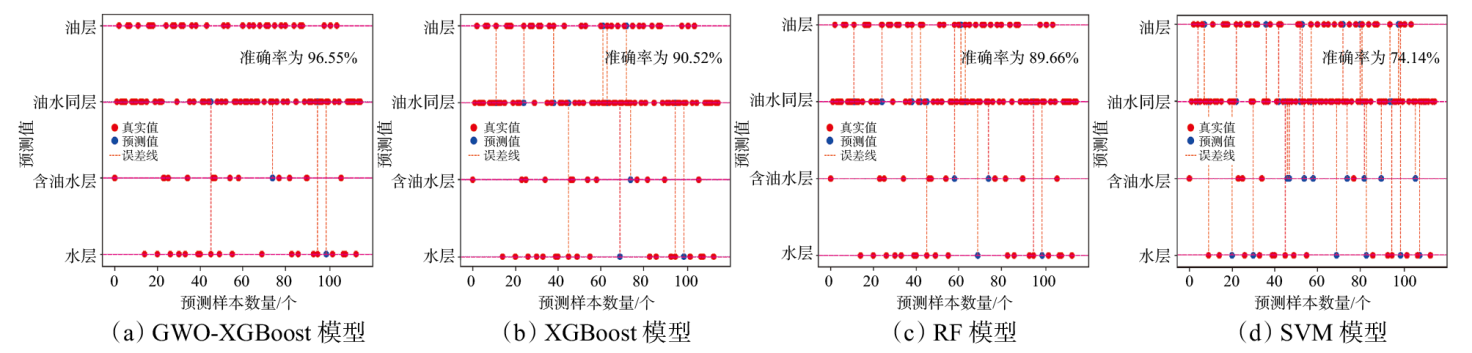
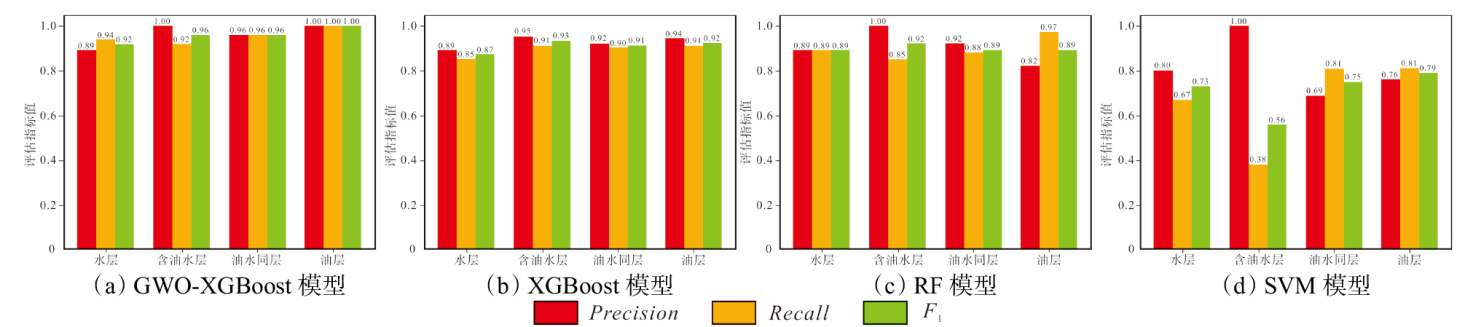
针对传统测井解释方法在致密砂岩储层流体类型上识别精度低的问题,提出了一种基于测井曲线的GWO-XGBoost模型储层流体智能识别方法,并将该方法应用于鄂尔多斯盆地洪德地区三叠系长8段致密砂岩储层中。研究结果表明:①以鄂尔多斯盆地洪德地区三叠系长8段实际试油数据为目标变量,经主成分分析法优选出声波、自然电位、密度、井径、中子、自然伽马、电阻率测井(AT20、AT60和AT90)等9条测井曲线作为特征参数,再通过灰狼优化算法(GWO)对XGBoost模型的关键超参数进行全局优化。②GWO-XGBoost模型对储层流体类型的识别准确率达到96.55%,相较于XGBoost、随机森林(RF)和支持向量机(SVM)模型,其识别精度分别提升了6.03%,6.89%和22.41%,展现出明显的优势。③实际单井应用中,GWO-XGBoost模型通过对多维测井响应特征的综合分析与非线性特征学习,能够有效解决人工解释中低阻油层与高阻水层易混淆的难题,该模型在复杂储层条件下具有较高的稳定性与可靠性,可为提高致密砂岩油气勘探开发效率提供技术支撑。
中图分类号:
- TE121.1









| [1] |
雷涛, 莫松宇, 李晓慧, 等. 鄂尔多斯盆地大牛地气田二叠系山西组砂体叠置模式及油气开发意义[J]. 岩性油气藏, 2024, 36(2):147-159.
doi: 10.12108/yxyqc.20240214 |
| LEI Tao, MO Songyu, LI Xiaohui, et al. Sandbody superimposition patterns and oil and gas exploration significance of Permian Shanxi Formation in Daniudi gas field,Ordos Basin[J]. Lithologic Reservoirs, 2024, 36(2):147-159. | |
| [2] |
杨为华. 松辽盆地双城断陷白垩系营城组四段致密油成藏主控因素及模式[J]. 岩性油气藏, 2024, 36(4):25-34.
doi: 10.12108/yxyqc.20240403 |
| YANG Weihua. Hydrocarbon accumulation model and main controlling factors of tight oil of the fourth member of Cretaceous Yingcheng Formation in Shuangcheng fault depression,Songliao Basin[J]. Lithologic Reservoirs, 2024, 36(4):25-34. | |
| [3] |
ZHAO Wenwen, ZHANG Zhaohui, LIAO Jianbo, et al. Prediction method for the porosity of tight sandstone constrained by lithofacies and logging resolution[J]. Marine and Petroleum Geology, 2024, 170:107114.
doi: 10.1016/j.marpetgeo.2024.107114 |
| [4] |
ZHANG Zhaohui, LI Zhiyong, DENG Xiuqin, et al. Multi-parameters logging identifying method for sand body architectures of tight sandstones:A case from the Triassic Chang 9 member,Longdong area,Ordos Basin,NW China[J]. Journal of Petroleum Science and Engineering, 2022, 216:110824.
doi: 10.1016/j.petrol.2022.110824 |
| [5] |
毛克宇. 梨树断陷营城组致密砂岩测井流体识别方法及其适应性分析[J]. 地球科学进展, 2016, 31(10):1056-1066.
doi: 10.11867/j.issn.1001-8166.2016.10.1056 |
|
MAO Keyu. Logs fluid typing methods and adaptive analysis of tight sandstone reservoir of Yingcheng Formation in Lishu Fault[J]. Advances in Earth Science, 2016, 31(10):1056-1066.
doi: 10.11867/j.issn.1001-8166.2016.10.1056 |
|
| [6] | 陈明江, 李洪玺, 赵辉, 等. 基于电阻率变化率的低阻油层测井识别新方法[J]. 地球物理学进展, 2022, 37(5):1933-1940. |
| CHEN Mingjiang, LI Hongxi, ZHAO Hui, et al. Innovative method for identifying low-resistivity oil reservoir based on well-logging resistivity gradient[J]. Progress in Geophysics, 2022, 37(5):1933-1940. | |
| [7] | 刘之的, 王联国, 吴泽民, 等. 基于多源测井信息融合的低阻油层识别研究[J]. 地球物理学进展, 2022, 37(3):1093-1099. |
| LIU Zhidi, WANG Lianguo, WU Zemin, et al. Identifying the low resistivity reservoir based on multi-source fusion using logging data[J]. Progress in Geophysics, 2022, 37(3):1093-1099. | |
| [8] |
白泽, 谭茂金, 石玉江, 等. 致密砂岩低阻油层成因与测井流体识别方法研究:以陇东西部地区长8组为例[J]. 石油物探, 2022, 61(4):750-760.
doi: 10.3969/j.issn.1000-1441.2022.04.018 |
|
BAI Ze, TAN Maojin, SHI Yujiang, et al. Genesis of low-resistivity oil pays and a fluid identification method for tight sandstone reservoirs:A case study of the Chang 8 Formation in the Longdong West area,Ordos Basin[J]. Geophysical Prospecting for Petroleum, 2022, 61(4):750-760.
doi: 10.3969/j.issn.1000-1441.2022.04.018 |
|
| [9] | 凡睿, 周林, 吴俊, 等. 川东北地区须家河组致密砂岩储层流体识别方法研究[J]. 油气地质与采收率, 2015, 22(3):67-71. |
| FAN Rui, ZHOU Lin, WU Jun, et al. Research on tight sandstone reservoir fluids identification in Xujiahe Formation,northeastern Sichuan basin[J]. Petroleum Geology and Reco-very Efficiency, 2015, 22(3):67-71. | |
| [10] | 程希, 任战利. 人工智能测井:基础、原理、技术及应用[J]. 煤田地质与勘探, 2024, 52(8):145-164. |
| CHENG Xi, REN Zhanli. Artificial intelligence logging:Fundamental,principle,technique,and application[J]. Coal Geology & Exploration, 2024, 52(8):145-164. | |
| [11] | 李鹏举, 张智鹏, 姜大鹏. 核磁共振测井流体识别方法综述[J]. 测井技术, 2011, 35(5):396-401. |
| LI Pengju, ZHANG Zhipeng, JIANG Dapeng. Review on fluid identification methods with NMR Logging[J]. Well Logging Technology, 2011, 35(5):396-401. | |
| [12] | 龚宇, 刘迪仁. 基于门控循环单元网络的低阻油层测井流体识别方法[J]. 科学技术与工程, 2024, 24(12):4932-4941. |
| GONG Yu, LIU Diren. Fluid identification method for low resisti-vity reservoir logging based on gated recurrent unit network[J]. Science Technology and Engineering, 2024, 24(12):4932-4941. | |
| [13] | 张银德, 童凯军, 郑军, 等. 支持向量机方法在低阻油层流体识别中的应用[J]. 石油物探, 2008, 47(3):306-310. |
| ZHANG Yinde, TONG Kaijun, ZHENG Jun, et al. Application of support vector machine method for identifying fluid in low-resistivity oil layers[J]. Geophysical Prospecting for Petroleum, 2008, 47(3):306-310. | |
| [14] |
何健, 文晓涛, 李波, 等. 基于随机森林算法的叠前流体识别[J]. 石油学报, 2022, 43(3):376-385.
doi: 10.7623/syxb202203005 |
|
HE Jian, WEN Xiaotao, LI Bo, et al. The pre-stack fluid identification method based on random forest algorithm[J]. Acta Petrolei Sinica, 2022, 43(3):376-385.
doi: 10.7623/syxb202203005 |
|
| [15] | 韩玉娇. 基于AdaBoost机器学习算法的大牛地气田储层流体智能识别[J]. 石油钻探技术, 2022, 50(1):112-118. |
| HAN Yujiao. Intelligent fluid identification based on the AdaBoost machine learning algorithm for reservoirs in Daniudi gas field[J]. Petroleum Drilling Techniques, 2022, 50(1):112-118. | |
| [16] |
YIN Wenjing, LI Hengxiao, ZHAO Zhiyuan, et al. Revolutioni-zing fluid identification in well logging data with a novel framework of progressive gated transformers and multi-scale temporal features[J]. Physics of Fluids, 2025, 37(1):016606.
doi: 10.1063/5.0245543 |
| [17] |
DIETTERICH T G. An experimental comparison of three methods for constructing ensembles of decision trees:Bagging,boosting,and randomization[J]. Machine Learning, 2000, 40(2):139-157.
doi: 10.1023/A:1007607513941 |
| [18] |
LOU Jingyao, XU Xiaohong, ZHAO Zhongxiang, et al. Fluid identification using XGBoost combined with MAHAKIL in low-permeability reservoirs[J]. SPE Journal, 2023, 29(1):203-214.
doi: 10.2118/217452-PA |
| [19] |
LI Hongxi, CHEN Mingjiang, ZHANG Xiankun, et al. Reservoir fluid identification based on bayesian-optimized SVM model[J]. Processes, 2025, 13(2):369.
doi: 10.3390/pr13020369 |
| [20] | 陈家鑫, 赵军龙, 崔文洁, 等. 基于GWO-XGBoost算法的流体识别:以陇东油田CX区长2储层为例[J]. 地球物理学进展, 2025, 40(3):1115-1124. |
| CHEN Jiaxin, ZHAO Junlong, CUI Wenjie, et al. Fluid identification based on GWO-XGBoost algorithm:Taking Chang 2 reservoir in CX area of Longdong oilfield as an example[J]. Progress in Geophysics, 2025, 40(3):1115-1124. | |
| [21] |
孙予舒, 黄芸, 梁婷, 等. 基于XGBoost算法的复杂碳酸盐岩岩性测井识别[J]. 岩性油气藏, 2020, 32(4):98-106.
doi: 10.12108/yxyqc.20200410 |
|
SUN Yushu, HUANG Yun, LIANG Ting, et al. Identification of complex carbonate lithology by logging based on XGBoost algorithm[J]. Lithologic Reservoirs, 2020, 32(4):98-106.
doi: 10.12108/yxyqc.20200410 |
|
| [22] |
刘迎宝, 李元昊, 翟文彬, 等. 极缓坡湖盆浅水三角洲前缘砂体类型及成因模式:以鄂尔多斯盆地郝滩地区三叠系长81亚段为例[J]. 岩性油气藏, 2025, 37(3):140-152.
doi: 10.12108/yxyqc.20250313 |
|
LIU Yingbao, LI Yuanhao, ZHAI Wenbin, et al. Types and genetic models of sand bodies in shallow water delta front of extremely gentle slope lake basin:A case study of Chang 81 submember of Triassic in Haotan area,Ordos Basin[J]. Lithologic Reservoirs, 2025, 37(3):140-152.
doi: 10.12108/yxyqc.20250313 |
|
| [23] |
张兆辉, 张皎生, 刘俊刚, 等. 鄂尔多斯盆地陇东地区三叠系长81亚段岩石相测井识别及勘探意义[J]. 岩性油气藏, 2025, 37(3):95-107.
doi: 10.12108/yxyqc.20250309 |
|
ZHANG Zhaohui, ZHANG Jiaosheng, LIU Jungang, et al. Lithofacies identification using conventional logging curves and its exploration significance,Triassic Chang 81 sub-member,Longdong area,Ordos Basin[J]. Lithologic Reservoirs, 2025, 37(3):95-107.
doi: 10.12108/yxyqc.20250309 |
|
| [24] | 杨华, 付金华, 何海清, 等. 鄂尔多斯华庆地区低渗透岩性大油区形成与分布[J]. 石油勘探与开发, 2012, 39(6):641-648. |
| YANG Hua, FU Jinhua, HE Haiqing, et al. Formation and distribution of large low-permeability lithologic oil regions in Huaqing,Ordos Basin[J]. Peteroleum Explortion and Development, 2012, 39(6):641-648. | |
| [25] |
肖文华, 杨军, 严宝年, 等. 鄂尔多斯盆地环庆地区三叠系长8致密砂岩储层特征及成藏主控因素[J]. 岩性油气藏, 2025, 37(3):23-32.
doi: 10.12108/yxyqc.20250303 |
|
XIAO Wenhua, YANG Jun, YAN Baonian, et al. Characteristics and main controlling factors of Triassic Chang 8 tight sandstone reservoirs in Huanqing area,Ordos Basin[J]. Lithologic Reservoirs, 2025, 37(3):23-32.
doi: 10.12108/yxyqc.20250303 |
|
| [26] | 肖正录, 李勇, 喻健, 等. 致密油“近源成藏”关键地球化学证据:以鄂尔多斯盆地延长组近源组合为例[J]. 石油实验地质, 2023, 45(3):517-527. |
| XIAO Zhenglu, LI Yong, YU Jian, et al. Key geochemical evidence of “near-source accumulation” of tight oil:A case study of near-source assemblage of Triassic Yanchang Formation in Ordos Basin[J]. Petroleum Geology & Experiment, 2023, 45(3):517-527. | |
| [27] | 周义军, 邓秀芹, 董迎春, 等. 鄂尔多斯盆地西缘天环坳陷洪德地区断裂发育特征及成藏意义[J]. 地质学报, 2025, 99(12):1-11. |
|
ZHOU Yijun, DENG Xiuqin, DONG Yingchun, et al. Characteristics of fault development and their significance in hydrocarbon accumulation in Hongde area,Tianhuan depression,western margin of Ordos basin[J]. Acta Geologica Sinica, 2025, 99(12):1-11.
doi: 10.1111/acgs.v99.1 |
|
| [28] |
牛小兵, 侯云超, 张晓磊, 等. 鄂尔多斯盆地西南缘洪德油田成藏条件及勘探开发关键技术[J]. 石油学报, 2025, 46(3):633-648.
doi: 10.7623/syxb202503012 |
|
NIU Xiaobing, HOU Yunchao, ZHANG Xiaolei, et al. Hydrocarbon accumulation conditions and key technologies of exploration and development of Hongde Oilfield in southwest Ordos Basin[J]. Acta Petrolei Sinica, 2025, 46(3):633-648.
doi: 10.7623/syxb202503012 |
|
| [29] |
杨占伟, 姜振学, 梁志凯, 等. 基于2种机器学习方法的页岩TOC含量评价:以川南五峰组—龙马溪组为例[J]. 岩性油气藏, 2022, 34(1):130-138.
doi: 10.12108/yxyqc.20220113 |
|
YANG Zhanwei, JIANG Zhenxue, LIANG Zhikai, et al. Evaluation of shale TOC content based on two machine learning methods:A case study of Wufeng-Longmaxi Formation in southern Sichuan Basin[J]. Lithologic Reservoirs, 2022, 34(1):130-138.
doi: 10.12108/yxyqc.20220113 |
|
| [30] | 钟高润, 任媛, 郭京哲, 等. 鄂尔多斯盆地中部延长组长6段低阻油层成因机理与测井识别[J]. 地球物理学进展, 2023, 38(5):2230-2238. |
| ZHONG Gaorun, REN Yuan, GUO Jingzhe, et al. Genetic mechanism and logging identification of low resistivity oil reservoir in Chang 6 member of Yanchang Formation,Ordos Basin[J]. Progress in Geophysics, 2023, 38(5):2230-2238. | |
| [31] |
付超, 林年添, 张栋, 等. 多波地震深度学习的油气储层分布预测案例[J]. 地球物理学报, 2018, 61(1):293-303.
doi: 10.6038/cjg2018L0193 |
| FU Chao, LIN Niantian, ZHANG Dong, et al. Prediction of reservoirs using multi-component seismic data and the deep learning method[J]. Chinese Journal of Geophysics (Acta Geophysica Sinica), 2018, 61(1):293-303. | |
| [32] |
杜睿山, 黄玉朋, 付晓飞, 等. 基于SMOTE和XGBoost的天然气水合物与天然气储层识别[J]. 特种油气藏, 2024, 31(5):11-19.
doi: 10.3969/j.issn.1006-6535.2024.05.002 |
| DU Ruishan, HUANG Yupeng, FU Xiaofei, et al. Identification of natural gas hydrates and natural gas reservoirs based on SMOTE and XGBoost[J]. Special Oil & Gas Reservoirs, 2024, 31(5):11-19. | |
| [33] | 田仁飞, 李山, 刘涛, 等. 基于XGBoost算法的vP/vS预测及其在储层检测中的应用[J]. 石油地球物理勘探, 2024, 59(4):653-663. |
| TIAN Renfei, LI Shan, LIU Tao, et al. vP/vS prediction based on XGBoost algorithm and its application in reservoir detection[J]. Oil Geophysical Prospecting, 2024, 59(4):653-663. | |
| [34] | 闫星宇, 顾汉明, 肖逸飞, 等. XGBoost算法在致密砂岩气储层测井解释中的应用[J]. 石油地球物理勘探, 2019, 54(2):447-455. |
| YAN Xingyu, GU Hanming, XIAO Yifei, et al. XGBoost algorithm applied in the interpretation of tight-sand gas reservoir on well logging data[J]. Oil Geophysical Prospecting, 2019, 54(2):447-455. | |
| [35] |
ZHAO Bin, LIAO Wenlong. Lithology identification of buried hill reservoir based on XGBoost with optimized interpretation[J]. Processes, 2025, 13(3):682.
doi: 10.3390/pr13030682 |
| [36] |
SHAHANI N M, ZHENG Xigui, WEI Xin, et al. Hybrid machine learning approach for accurate prediction of the drilling rate index[J]. Scientific Reports, 2024, 14(1):24080.
doi: 10.1038/s41598-024-75639-z |
| [37] |
UTKARSH, JAIN P K. Predicting bentonite swelling pressure:Optimized XGBoost versus neural networks[J]. Scientific Reports, 2024, 14(1):17533.
doi: 10.1038/s41598-024-68038-x |
| [38] |
宋宣毅, 刘月田, 马晶, 等. 基于灰狼算法优化的支持向量机产能预测[J]. 岩性油气藏, 2020, 32(2):134-140.
doi: 10.12108/yxyqc.20200215 |
|
SONG Xuanyi, LIU Yuetian, MA Jing, et al. Productivity forecast based on support vector machine optimized by grey wolf optimizer[J]. Lithologic Reservoirs, 2020, 32(2):134-140.
doi: 10.12108/yxyqc.20200215 |
|
| [39] |
TANG Chenhua, HUANG Changcheng, CHEN Yi, et al. Multi-strategy grey wolf optimizer for engineering problems and sewage treatment prediction[J]. Advanced Intelligent Systems, 2024, 6(7):2300406.
doi: 10.1002/aisy.v6.7 |
| [1] | 杨占龙, 郝彬, 谭开俊, 张晶, 张丽萍, 廖建波, 李在光, 史江龙. 中国陆上中小盆地群发育特征与油气勘探方向[J]. 岩性油气藏, 2026, 38(2): 12-31. |
| [2] | 周文娟, 蒲仁海, 卢子兴, 王康乐, 张鹏, 闻星宇, 王通, 关蕴文. 鄂尔多斯盆地中东部奥陶系马五段膏盐岩分布特征及主控因素[J]. 岩性油气藏, 2026, 38(2): 122-133. |
| [3] | 李涛, 马国福, 赵乐义, 袁莉, 马淇琳, 谢菁钰, 张博, 李赫楠. 鄂尔多斯盆地环县地区三叠系长7段烃源岩特征及油源对比[J]. 岩性油气藏, 2026, 38(2): 134-144. |
| [4] | 顾雯, 陈辉, 朱亚东, 巫芙蓉, 赵洲, 王书言, 王尉. 四川盆地蜀南地区三叠系嘉二段成藏主控因素及勘探方向[J]. 岩性油气藏, 2026, 38(2): 56-64. |
| [5] | 龙礼文, 肖文华, 严宝年, 王建国, 李少勇, 李丛林, 郭耀轩, 任雪瑶. 鄂尔多斯盆地环西地区三叠系长81油气成藏主控因素[J]. 岩性油气藏, 2026, 38(2): 65-75. |
| [6] | 彭芬, 任登峰, 彭建新, 魏红兴. 库车坳陷迪北气藏侏罗系阿合组致密储层流体活动属性约束反演方法[J]. 岩性油气藏, 2026, 38(2): 76-85. |
| [7] | 郭昱辛, 白玉彬, 赵靖舟, 张军, 曹丹丹. 鄂尔多斯盆地志丹地区三叠系长7泥页岩非均质性及控油作用[J]. 岩性油气藏, 2026, 38(2): 97-110. |
| [8] | 孟阳, 曹小朋, 赵浩, 杨明林, 李志鹏, 田振磊, 乌洪翠, 蒋越. 准噶尔盆地永进地区侏罗系齐古组天然裂缝发育特征及主控因素[J]. 岩性油气藏, 2026, 38(1): 13-25. |
| [9] | 张盟勃, 彭剑康, 崔晓杰, 张栋, 倪娜, 龙盛芳, 魏朋辉. 鄂尔多斯盆地米脂北地区石炭系本溪组煤岩气储层地震预测技术[J]. 岩性油气藏, 2026, 38(1): 162-171. |
| [10] | 荀小全, 李宏涛, 李长平, 杨帆, 刘雄. 强非均质性气藏压裂水平井分段产量劈分新方法——以鄂尔多斯盆地东胜气田二叠系盒1段气藏为例[J]. 岩性油气藏, 2026, 38(1): 191-200. |
| [11] | 殷疆, 焦雪君, 李小龙, 李泰福, 申战勇, 李梦茜, 孙睿, 朱玉双. 基于随机森林优化算法的低电阻率储层含油饱和度评价方法[J]. 岩性油气藏, 2026, 38(1): 55-66. |
| [12] | 江梦雅, 蒋中发, 刘龙松, 王江涛, 陈海龙, 王学勇, 刘海磊. 准噶尔盆地达巴松凸起三叠系白碱滩组油气地球化学特征及来源[J]. 岩性油气藏, 2025, 37(6): 71-87. |
| [13] | 苏帅, 屈红军, 尹虎, 张磊岗, 杨晓锋. 致密砂岩储层孔喉结构分形特征及其对储层物性的影响——以鄂尔多斯盆地富县地区三叠系长8段为例[J]. 岩性油气藏, 2025, 37(6): 88-98. |
| [14] | 缪志伟, 李世凯, 张文军, 肖伟, 刘明, 于童. “断缝体”致密砂岩复杂网状裂缝地震预测技术——以四川盆地北部三叠系须家河组为例[J]. 岩性油气藏, 2025, 37(6): 140-150. |
| [15] | 李春阳, 王勃力, 颜晓, 李可赛, 邓虎成, 苏锦义, 吴亚军, 叶泰然. 川东北元坝地区三叠系须家河组四段致密储层现今地应力测井评价[J]. 岩性油气藏, 2025, 37(6): 151-161. |
|
||
 甘公网安备 62010202002827号