岩性油气藏 ›› 2026, Vol. 38 ›› Issue (5): 170–178.doi: 10.12108/yxyqc.20260516
基于CT扫描三维重构的煤岩可压裂性实验
曾凡辉1( ), 杨维鑫1,2, 郭建春1, 张宇1, 张然3
- 1
西南石油大学·油气藏地质及开发工程全国重点实验室 成都 610500
2中国石化勘探分公司 成都 610051
3西华大学 机械工程学院 成都 611743
Experiment on the fracability of coal rocks based on CT scanning and 3D reconstruction
ZENG Fanhui1(), YANG Weixin1,2, GUO Jianchun1, ZHANG Yu1, ZHANG Ran3
- 1
State Key Laboratory of Oil and Gas Reservoir Geology and Exploitation·Southwest Petroleum University Chengdu 610500, China
2Sinopec Exploration Company Chengdu 610500, China
3School of Mechanical Engineering ,Xihua University Chengdu 611743, China
摘要:
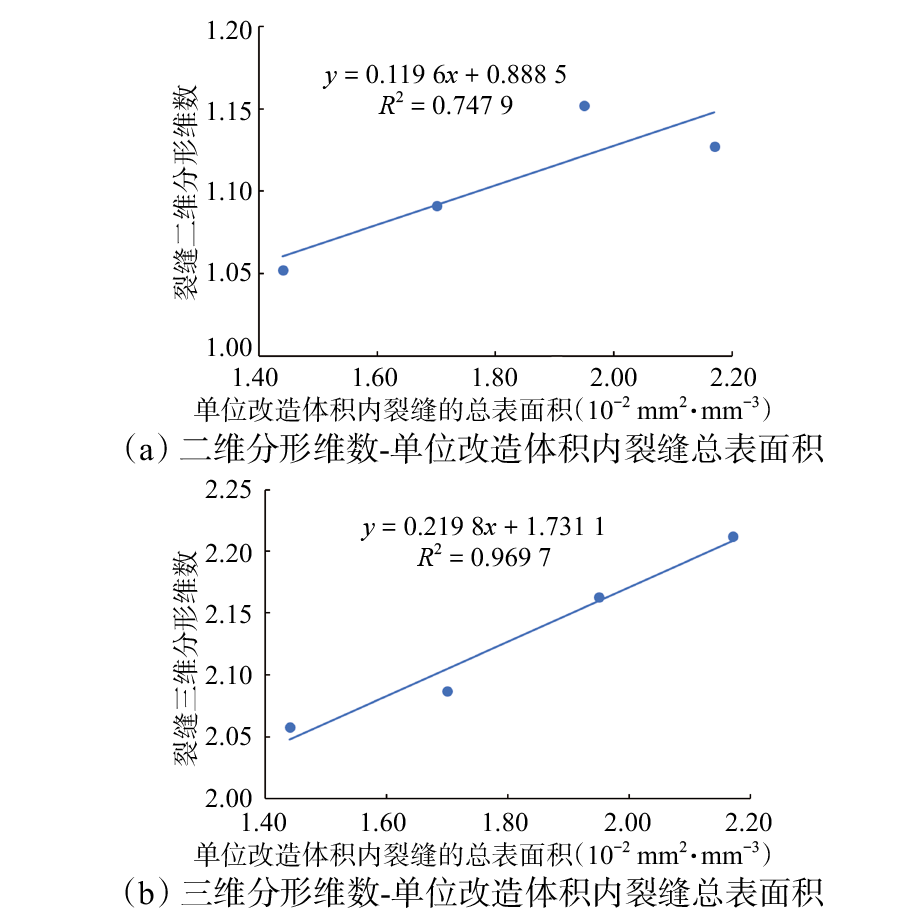
针对煤层气藏传统可压裂性评价方法难以兼顾裂缝形态与流动连通性的问题,利用真三轴水力压裂设备,以4组200 mm×200 mm×200 mm的原煤立方体样品开展不同压裂介质、不同地应力差、不同泵注速率条件下的压裂对比实验;结合高分辨率CT扫描与三维重构技术,定量获取裂缝表面积并计算三维分形维数,将可压裂性定义为单位改造体积内的裂缝总表面积,对不同应力条件与压裂流体类型对裂缝发育特征的影响进行了系统分析。研究结果表明:①液态CO2黏度低、扩散能力强,能够有效提高孔隙压力并降低破裂压力,显著增强裂缝复杂性;与清水相比,液态CO2作为压裂介质的起裂压力降低了13.8%,裂缝表面积增加了50.1%。②裂缝复杂度与三维分形维数呈高度正相关,三维分形维数可作为反映储层可压裂性的有效量化指标。③相同实验条件下,水平主应力差由5.00 MPa降至3.00 MPa时,储层可压裂性提高了14.7%;当泵注速率由30 mL/min提高至60 mL/min时,储层可压裂性提高了11.3%;相较于清水压裂,液态CO2压裂可使储层的可压裂性提高50.7%。
中图分类号:
- TE371
| [1] | 邹才能, 杨智, 黄士鹏, 等. 煤系天然气的资源类型,形成分布与发展前景[J]. 石油勘探与开发, 2019, 46(3):433-442. |
| ZOU Caineng, YANG Zhi, HUANG Shipeng, et al. Resource types,formation,distribution and prospects of coal-measure gas[J]. Petroleum Exploration and Development, 2019, 46(3):433-442. | |
| [2] | 王青, 田冲, 罗超, 等. 四川盆地遂宁—合江地区二叠系龙潭组煤岩气储层特征及勘探前景[J]. 岩性油气藏, 2025, 37(4):26-37. |
| WANG Qing, TIAN Chong, LUO Chao, et al. Characteristics and exploration prospects of coal-rock gas reservoirs in Per-mian Longtan Formation in Suining-Hejiang area,Sichuan Basin[J]. Lithologic Reservoirs, 2025, 37(4):26-37. | |
| [3] | ZENG Fanhui, PENG Fan, GUO Jianchun, et al. Gas transport study in the confined microfractures of coal reservoirs[J]. Journal of Natural Gas Science and Engineering, 2019, 68:102920. |
| [4] | 卞晓冰, 侯磊, 蒋廷学, 等. 深层页岩裂缝形态影响因素[J]. 岩性油气藏, 2019, 31(6):161-168. |
| BIAN Xiaobing, HOU Lei, JIANG Tingxue, et al. Influencing factors of fracture geometry in deep shale gas wells[J]. Lithologic Reservoirs, 2019, 31(6):161-168. | |
| [5] | ZENG Fanhui, GONG Gaobin, ZHANG Yu, et al. Fracability evaluation of shale reservoirs considering rock brittleness,fracture toughness,and hydraulic fracturing-induced effects[J]. Geoenergy Science and Engineering, 2023, 229:1-14. |
| [6] | CHONG K K, GRIESER W V, PASSMAN A, et al. A completions guide book to shale-play development:A review of successful approaches towards shale-play stimulation in the last two decades[R]. Calgary, Society of Petroleum Engineers Canadian Unconventional Resources and International Petroleum Conference, 2010. |
| [7] | LI Jianhua, XIE Heping, LU Jun, et al. New permeability model of deep coal rock considering the structure and 3D stress compression-induced anisotropy[J]. Geomechanics and Geophysics for Geo-Energy and Geo-Resources, 2022, 8(6):204. |
| [8] | 彭文春, 米洪刚, 徐立富, 等. 神府区块深部煤储层可压性评价方法及应用[J]. 煤炭科学技术, 2025, 53(3):238-247. |
| PENG Wenchun, MI Honggang, XU Lifu, et al. Fracability evaluation and classification of deep coal reservoirs in the Shenfu block[J]. Coal Science and Technology, 2025, 53(3):238-247. | |
| [9] | 李倩, 李童, 蔡益栋, 等. 煤层气储层水力裂缝扩展特征与控因研究进展[J]. 煤炭学报, 2023, 48(12):4443-4460. |
| LI Qian, LI Tong, CAI Yidong, et al. Research progress on hydraulic fracture characteristics and controlling factors of coalbed methane reservoirs[J]. Journal of China Coal Society, 2023, 48(12):4443-4460. | |
| [10] | CHEN Lipeng, WANG Lei, LIU Huaiqian, et al. Study on the micro-fracture-structure and permeability behavior of coal under the action of CO2 based on micro-CT[J]. Geomechanics and Geophysics for Geo-Energy and Geo-Resources, 2025, 11(1):25. |
| [11] | 孟召平, 刘翠丽, 纪懿明. 煤层气/页岩气开发地质条件及其对比分析[J]. 煤炭学报, 2013, 38(5):728-736. |
| MENG Zhaoping, LIU Cuili, JI Yiming. Geological conditions of coalbed methane and shale gas exploitation and their comparison analysis[J]. Journal of China Coal Society, 2013, 38(5):728-736. | |
| [12] | 翟文宝, 李军, 周英操, 等. 基于测井资料的页岩储层可压裂性评价新方法[J]. 岩性油气藏, 2018, 30(3):112-123. |
| ZHAI Wenbao, LI Jun, ZHOU Yingcao, et al. New evaluation method of shale reservoir fracability based on logging data[J]. Lithologic Reservoirs, 2018, 30(3):112-123. | |
| [13] | YUAN Junliang, ZHOU Jianliang, LIU Shujie, et al. An improved fracability-evaluation method for shale reservoirs based on new fracture toughness-prediction models[J]. SPE Journal, 2017, 22(5):1704-1713. |
| [14] | JIN Xiaochun, SHAH S N, ROEGIERS J C, et al. An integrated petrophysics and geomechanics approach for fracability evaluation in shale reservoirs[J]. SPE Journal, 2015, 20(3):518-526. |
| [15] | 艾林, 周明顺, 张杰, 等. 基于煤岩脆性指数的煤体结构测井定量判识[J]. 岩性油气藏, 2017, 29(2):139-144. |
| AI Lin, ZHOU Mingshun, ZHANG Jie, et al. Quantitative identification of coal structure based on coal rock brittleness index by logging data[J]. Lithologic Reservoirs, 2017, 29(2):139-144. | |
| [16] | LI Yuwei, LONG Min, ZUO Lihua, et al. Brittleness evaluation of coal based on statistical damage and energy evolution theory[J]. Journal of Petroleum Science and Engineering, 2019, 172:753-763. |
| [17] | JARVIE D M, HILL R J, RUBLE T E, et al. Unconventional shale-gas systems:The Mississippian Barnett Shale of north-central Texas as one model for thermogenic shale-gas assessment[J]. AAPG Bulletin, 2007, 91(4):475-499. |
| [18] | 袁俊亮, 邓金根, 张定宇, 等. 页岩气储层可压裂性评价技术[J]. 石油学报, 2013, 34(3):523-527. |
| YUAN Junliang, DENG Jingen, ZHANG Dingyu, et al. Fracability evaluation of shale-gas reservoirs[J]. Acta Petrolei Sinica, 2013, 34(3):523-527. | |
| [19] | 王登科, 曾凡超, 王建国, 等. 显微工业CT的受载煤样裂隙动态演化特征与分形规律研究[J]. 岩石力学与工程学报, 2020, 39(6):1165-1174. |
| WANG Dengke, ZENG Fanchao, WANG Jianguo, et al. Dynamic evolution characteristics and fractal law of loaded coal fractures by micro industrial CT[J]. Chinese Journal of Rock Mechanics and Engineering, 2020, 39(6):1165-1174. | |
| [20] | SUI Lili, JU Yang, YANG Yongming, et al. A quantification method for shale fracability based on analytic hierarchy process[J]. Energy, 2016, 115:637-645. |
| [21] | SUI Lili, YU Jian, CANG Dingbang, et al. The fractal description model of rock fracture networks characterization[J]. Chaos,Solitons & Fractals, 2019, 129:71-76. |
| [22] | WANG Fei, WU Xiang, DUAN Chaowei, et al. Quantitative characterization and fracturability evaluation of shale fractures based on 3D CT reconstruction[J]. Progress in Geophysics, 2023, 38(5):2147-2159. |
| [23] | 蒋长宝, 付银兰, 王光淇. 水力压裂煤裂隙网络表征与造缝性能评估试验研究[J]. 煤炭科学技术, 2023, 51(6):62-71. |
| JIANG Changbao, FU Yinlan, WANG Guangqi. Experimental study on characterization hydraulic fracturing coal fracture network and evolution of fracture forming performance[J]. Coal Science and Technology, 2023, 51(6):62-71. | |
| [24] | CIPOLLA C L, WARPINSKI N R, MAYERHOFER M J, et al. The relationship between fracture complexity,reservoir properties,and fracture-treatment design[J]. SPE Production & Operations, 2010, 25(4):438-452. |
| [25] | 侯冰, 陈勉, 李志猛, 等. 页岩储集层水力裂缝网络扩展规模评价方法[J]. 石油勘探与开发, 2014, 41(6):763-768. |
| HOU Bing, CHEN Mian, LI Zhimeng, et al. Propagation area evaluation of hydraulic fracture networks in shale gas reservoirs[J]. Petroleum Exploration and Development, 2014, 41(6):763-768. | |
| [26] | 刘向君, 王小军, 赵保伟, 等. 砂砾岩储集层水力压裂裂缝扩展规律与可压性评价[J]. 新疆石油地质, 2023, 44(2):169-177. |
| LIU Xiangjun, WANG Xiaojun, ZHAO Baowei, et al. Propagation of hydraulic fractures and fracability evaluation of sandy conglomerate reservoirs[J]. Xinjiang Petroleum geology, 2023, 44(2):169-177. | |
| [27] | 丁勇, 马新星, 叶亮, 等. CO2破岩机理及压裂工艺技术研究[J]. 岩性油气藏, 2018, 30(6):151-159. |
| DING Yong, MA Xinxing, YE Liang, et al. Rock breaking mechanism of CO2 and fracturing technology[J]. Lithologic Reservoirs, 2018, 30(6):151-159. | |
| [28] | 寇淑清, 杨宏宇, 高岩, 等. 裂解连杆断裂结合面缺损面积定量描述与分析[J]. 吉林大学学报(工学版), 2013, 43(6):1541-1545. |
| KOU Shuqing, YANG Hongyu, GAO Yan, et al. Quantitative description and analysis of defect area of fracture surface of splitting connecting rod[J]. Journal of Jilin University (Engineering and Technology Edition), 2013, 43(6):1541-1545. | |
| [29] | 徐祖新. 基于CT扫描图像的页岩储层非均质性研究[J]. 岩性油气藏, 2014, 26(6):46-49. |
| XU Zuxin. Heterogeneity of shale reservoirs based on CT images[J]. Lithologic Reservoirs, 2014, 26(6):46-49 | |
| [30] | WU Mingyang, WANG Wensong, SHI Di, et al. Improved box-counting methods to directly estimate the fractal dimension of a rough surface[J]. Measurement, 2021, 177:109303. |
| [1] | 黄力, 赵龙梅, 陈东, 赵浩阳, 张艺馨, 石石, 张稳, 季亮. 鄂尔多斯盆地宜川地区石炭系—二叠系煤岩气储层特征及勘探潜力[J]. 岩性油气藏, 2026, 38(5): 40-50. |
| [2] | 赵森, 陈胜, 李新豫, 杜文辉, 王秀姣, 杨昊, 李艳东, 代春萌. 基于混合随机森林的煤岩气储层孔隙度地震智能预测方法——以鄂尔多斯盆地米脂北地区石炭系本溪组8#煤为例[J]. 岩性油气藏, 2026, 38(5): 159-169. |
| [3] | 张盟勃, 彭剑康, 崔晓杰, 张栋, 倪娜, 龙盛芳, 魏朋辉. 鄂尔多斯盆地米脂北地区石炭系本溪组煤岩气储层地震预测技术[J]. 岩性油气藏, 2026, 38(1): 162-171. |
| [4] | 张衍君, 刘拯君, 徐豪, 贺文杰, 刘亚茹, 邢亮, 周德胜, 王祯. 页岩油储层前置CO2压裂液体滞留效应研究进展[J]. 岩性油气藏, 2026, 38(1): 180-190. |
| [5] | 苏帅, 屈红军, 尹虎, 张磊岗, 杨晓锋. 致密砂岩储层孔喉结构分形特征及其对储层物性的影响——以鄂尔多斯盆地富县地区三叠系长8段为例[J]. 岩性油气藏, 2025, 37(6): 88-98. |
| [6] | 田继先, 石正灏, 李剑, 沙威, 蒋峥文, 杨磊, 鱼雪, 蒲永霞. 柴达木盆地侏罗系煤岩气成藏条件与勘探潜力[J]. 岩性油气藏, 2025, 37(4): 17-25. |
| [7] | 王青, 田冲, 罗超, 张景缘, 杨雪, 吴伟, 陶夏妍. 四川盆地遂宁—合江地区二叠系龙潭组煤岩气储层特征及勘探前景[J]. 岩性油气藏, 2025, 37(4): 26-37. |
| [8] | 李道清, 陈永波, 杨东, 李啸, 苏航, 周俊峰, 仇庭聪, 石小茜. 准噶尔盆地白家海凸起侏罗系西山窑组煤岩气“甜点”储层智能综合预测技术[J]. 岩性油气藏, 2024, 36(6): 23-35. |
| [9] | 唐述凯, 郭天魁, 王海洋, 陈铭. 致密储层缝内暂堵转向压裂裂缝扩展规律数值模拟[J]. 岩性油气藏, 2024, 36(4): 169-177. |
| [10] | 张凤奇, 李宜浓, 罗菊兰, 任小锋, 张兰馨, 张芥瑜. 鄂尔多斯盆地西部奥陶系乌拉力克组页岩微观孔隙结构特征[J]. 岩性油气藏, 2022, 34(5): 50-62. |
| [11] | 梁志凯, 李卓, 李连霞, 姜振学, 刘冬冬, 高凤琳, 刘晓庆, 肖磊, 杨有东. 松辽盆地长岭断陷沙河子组页岩孔径多重分形特征与岩相的关系[J]. 岩性油气藏, 2020, 32(6): 22-35. |
| [12] | 王香增, 孙晓, 罗攀, 穆景福. 非常规油气CO2压裂技术进展及应用实践[J]. 岩性油气藏, 2019, 31(2): 1-7. |
| [13] | 丁勇, 马新星, 叶亮, 肖元相, 张燕明, 古永红, 马超星. CO2破岩机理及压裂工艺技术研究[J]. 岩性油气藏, 2018, 30(6): 151-159. |
| [14] | 曹涛涛, 邓模, 刘虎, 宋之光, 曹清古, 黄俨然. 可溶有机质对泥页岩储集物性的影响[J]. 岩性油气藏, 2018, 30(3): 43-51. |
| [15] | 朱汉卿, 贾爱林, 位云生, 贾成业, 金亦秋, 袁贺. 基于氩气吸附的页岩纳米级孔隙结构特征[J]. 岩性油气藏, 2018, 30(2): 77-84. |
|
||
 甘公网安备 62010202002827号